Timing Belt Guide
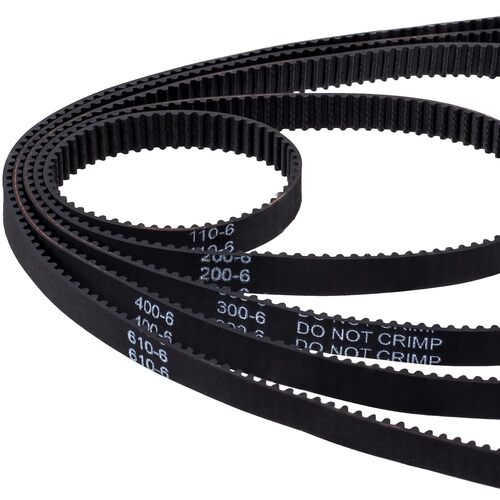
Timing belts are toothed rubber belts used to transmit motion between rotating shafts or create light duty linear drives. We commonly use them to couple DC motors or stepper motors to mechanisms. The primary benefit is the ability to separate the motor and load shafts without needing complex gear trains, while also providing an opportunity for transmission reduction. If a small motor pulley drives a larger pulley, the transmission reduces the speed and increases the torque. Timing belts also add drive compliance, can be low-backlash, and are tolerant of shaft misalignment and mechanical imprecision.
Timing belts are commonly sold as endless belts selected from a catalog of specific lengths defined by the number of teeth. A common design problem is choosing the pulley diameters and relative center positions so the matching belt is available within the standard lengths.
There are different sizes of miniature timing belts and pulleys, primarily described by the tooth-to-tooth distance. For this course, we recommend the ‘GT2’ series with 2 mm spacing between teeth.
For more details on our lab stock, please see Lab Inventory: Timing Belts and Pulleys.
Two-Pulley Drive Design
One of the most common design cases is transmitting motion between two parallel shafts, often a motor and a load. A general procedure for choosing parts is as follows:
Select a belt series; for most of our course applications, the GT2 series with 2 mm pitch is recommended.
Select a drive ratio. E.g. if the motor speed needs to be reduced and torque increased, choose a ratio such as 1:3 between a small motor pulley and a larger load pulley. A single stage reduction might typically range between 1:1 and 1:6. With larger ratios, the larger pulley can get quite large; a 160 tooth GT2 pulley has 320 mm circumference and is about 102 mm in diameter.
Select specific pulley sizes. Commercial pulleys may be selected from a catalog set of sizes specified by the number of teeth, e.g. McMaster-Carr stocks GT2 pulleys ranging from 12 to 120 teeth. The lab only stocks a few small sizes, so in most cases we fabricate custom pulleys. The SolidWorks reference models include a design table for generating any size pulley, and a number of sizes are pre-defined. Just a few of these sizes are pre-rendered as DXF files.
Select a hub and shaft design.
If you are laser-cutting your own pulleys from flat stock, some bore options include a hole pattern for a metal hub, plain bore (e.g. for a shaft), a D-shaped bore to press-fit onto a motor shaft (marginal).
If you are purchasing commercial pulleys, the hub design is often linked to the material choice, but commonly includes plain bore and set screw options.
Select pulley material. Commercial pulleys are often available in aluminum or Delrin. Laser-cut pulleys may be plywood or acrylic. Plywood is marginal for small GT2 pulleys, the features may be too imprecise for good belt traction, but works fine at large sizes.
Calculate a center-to-center distance between the two parallel shafts. This is a function of the belt series and the pulley diameters; please consult one of the online calculators below.
Select a belt tensioning strategy. Timing belts are tolerant to misalignment and shaft distance error, but will function best if calibrated for a lightly snug fit with minimum backlash. The simplest way to achieve this is to mount one component such as a motor in slots so it may be lightly pretensioned during assembly.
Select a belt assembly strategy. An endless timing belt often represents an assembly constraint, especially in tight spaces or if other components run through the opening or nearby. Frequently a belt needs to be partially assembled over shafts early in an assembly process, then wrapped around the pulleys only after other components are mounted.
Timing Belt Calculators
For a command-line Python script to help calculate parameters for timing belt drive systems, please see Timing Belt Calculator (console).
Several companies have online calculators for computing pulley placement or belt length:
Resources
GT2 timing belts and pulleys are used in many DIY 3D printer designs and have become available at low prices via Amazon. Some common pulley sizes with a 5mm bore to match our stepper motors are 16 or 20 tooth. The belting is most often sold open-ended which is suitable for long linear or reciprocating drives, but with stock a few sizes of endless belts, and more are available commercially.
McMaster-Carr has a large stock of standard miniature timing belts and pulleys. Many sizes are available from the Cleveland warehouse with one day lead time via ground shipping:
Stock Drive Products has an 86-page technical guide online describing the use of their timing belt products:
Common Timing Belt Profiles
series |
units |
pitch |
tooth height |
thickness |
|---|---|---|---|---|
GT2 |
mm |
2.00 |
0.76 |
1.52 |
MXL |
inch |
0.080 |
0.02 |
0.045 |
XL |
inch |
0.200 |
0.05 |
0.090 |
L |
inch |
0.375 |
0.075 |
0.140 |
Standard Endless Belt Sizes
The following belt sizes, specified in the number of teeth, are commonly available. Open-ended stock is also available for linear drives.
GT2 (2.0 mm pitch) Common Lengths (teeth)
GT2 belts have 2 mm pitch, so the actual belt length is the number of teeth multipled by 2 mm.
Our lab inventory includes the following belt tooth counts in 6 mm width:
110, 150, 200, 300, 400, 610
McMaster-Carr stocks the following belt tooth counts in 6 mm width:
50, 56, 62, 63, 67, 68, 70, 76, 79, 80, 82, 86, 90, 93, 96, 100, 101, 160, 110, 116, 118, 120, 125, 126, 129, 140, 150, 160, 166, 175, 185, 190, 200, 210, 228, 244, 252, 264, 276, 288, 300, 320, 348, 372, 424, 582
The Stock Drive Products catalog has many more standard sizes.
MXL (0.080 inch pitch) Common Lengths (teeth)
40, 45, 50, 55, 60, 70, 80, 85, 90, 95, 100, 105, 110, 114, 120, 130, 140, 144, 150, 153, 155, 165, 175, 184, 190, 200, 210, 212, 225, 250, 260, 295, 300, 400, 498
XL (0.200 inch pitch) Common Lengths (teeth)
25, 30, 35, 40, 45, 50, 55, 60, 65, 70, 75, 80, 85, 90, 95, 100, 105, 110, 115, 120, 125, 130, 140, 145, 150, 155, 165, 170, 175, 185, 190, 195, 200, 210, 225, 240, 250, 285, 315, 385