Array
This sample project includes a robot which consists of a grid of actuators driving pivoting passive elements. This model demonstrates several key concepts: underactuated systems, generative movement, and scripted modeling.
This model is demonstrated in the array.wbt world. The base link for all
actuators has a NULL Physics object so it does not move, simulating a rigid
connection to the ground. Each link has a simple box boundingObject for
collision detection and physics mass parameter calculations.
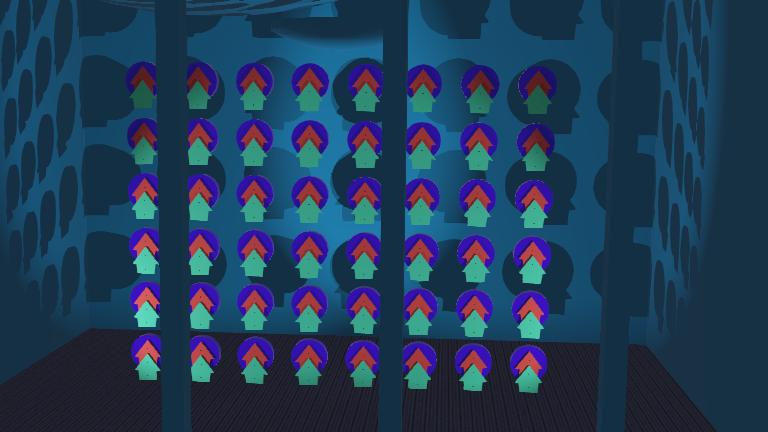
Screenshot of Webots model of the array robot.
Sample Robot Control Code
  1# array.py
  2#
  3# Sample Webots controller file for driving the array
  4# of underactuated two-joint devices.
  5#
  6# No copyright, 2020-2023, Garth Zeglin.  This file is
  7# explicitly placed in the public domain.
  8
  9print("loading array.py...")
 10
 11import math
 12import random
 13import numpy as np
 14
 15# Import the Webots simulator API.
 16from controller import Supervisor
 17
 18# Define the time step in milliseconds between controller updates.
 19EVENT_LOOP_DT = 20
 20
 21################################################################
 22# The sample controller is defined as an class which is then instanced as a
 23# singleton control object.  This is conventional Python practice and also
 24# is closer to practices involving the physical hardware.
 25
 26class ArrayRobot(Supervisor):
 27    def __init__(self):
 28
 29        # Initialize the superclass which implements the Robot API.
 30        super().__init__()
 31
 32        robot_name = self.getName()
 33        print("%s: controller connected." % (robot_name))
 34
 35        # Read back the array dimensions.  This is possible because the Robot is
 36        # configured with Supervisor permissions.
 37        num_x = self.getSelf().getField('num_x').value
 38        num_y = self.getSelf().getField('num_y').value
 39        print("Array has %d x %d units." % (num_x, num_y))
 40
 41        # Fetch handles for the motors into a 2D array.  The naming scheme is defined in
 42        # the proto file for the array.
 43        j = []
 44        for x in range(1,num_x+1):
 45            row = []
 46            for y in range(1,num_y+1):
 47                name = "motor%d%d" % (x, y)
 48                # print("Fetching motor", name)
 49                row.append(self.getDevice(name))
 50            j.append(row)
 51        self.joints = j
 52
 53        # Configure the motors for velocity control by setting
 54        # the position targets to infinity.
 55        for row in self.joints:
 56            for motor in row:
 57                motor.setPosition(float('inf'))
 58                motor.setVelocity(0.0)
 59
 60        # Create a numpy array with a velocity for each motor.
 61        self.velocity = np.zeros((num_x, num_y))
 62
 63        # Create some additional constant index arrays useful for generative functions.
 64        # Each of these has the same shape as the motor array.
 65        # x_mesh varies only the grid 'X' direction, y_mesh varies only along the grid 'Y' direction.
 66        self.y_mesh, self.x_mesh = np.meshgrid(np.linspace(0, num_y-1, num_y), np.linspace(0, num_x-1, num_x))
 67
 68        # Initialize the performance state.
 69        self.state = 'init'
 70        self.new_state = True
 71        self.state_timer = 0
 72        self.current_time = 0.0
 73
 74        return
 75
 76    #----------------------------------------------------------------
 77    # internal method to set the velocity of each motor to the current velocity grid value
 78    def _update_motor(self):
 79        for vel_row, motor_row in zip(self.velocity, self.joints):
 80            for vel, motor in zip(vel_row, motor_row):
 81                motor.setVelocity(vel)
 82
 83    #----------------------------------------------------------------
 84    # set every motor to zero velocity
 85    def stop_all(self):
 86        self.velocity[:,:] = 0.0
 87        self._update_motor()
 88
 89    # set every motor to a specific velocity
 90    def unison(self, velocity):
 91        self.velocity[:,:] = velocity
 92        self._update_motor()
 93
 94    # mirror the left half velocity onto the right half
 95    def lateral_mirror(self):
 96        width = self.velocity.shape[1]
 97        halfwidth = width // 2
 98        self.velocity[:,halfwidth:width] = -self.velocity[:, (halfwidth-1)::-1]
 99        self._update_motor()
100
101    # set every motor to a reasonable random velocity (positive and negative)
102    def randomize_velocity(self):
103        self.velocity = 3 - 6*np.random.rand(*self.velocity.shape)
104        self._update_motor()
105
106    # set every motor to wave function varying along the X direction.  Note: in the sample model, the
107    # array has been rotated so this is vertical
108    def wave_x(self):
109        period = 3.0
110        phase_velocity = 2*math.pi / period
111        phase = self.x_mesh
112        self.velocity = 3 * np.sin((phase_velocity * self.current_time) + 0.5*phase)
113        self._update_motor()
114
115    # set every motor to wave function varying along the Y direction.  Note: in the sample model, this
116    # is the horizontal direction across the room.
117    def wave_y(self):
118        period = 3.0
119        phase_velocity = 2*math.pi / period
120        phase = self.y_mesh
121        self.velocity = 1.5 + 1.5 * np.sin((phase_velocity * self.current_time) + 0.3*phase)
122        self._update_motor()
123
124    #----------------------------------------------------------------
125    # Implement state machine for the overall performance state, updated
126    # at the main event rate.
127    def poll_performance_state(self):
128
129        # implement a basic timer used by many states
130        timer_expired = False
131        self.state_timer -= 0.001*EVENT_LOOP_DT
132        if self.state_timer < 0:
133            timer_expired = True
134
135        # implement entry flag logic used by many state
136        new_state = self.new_state
137        self.new_state = False
138
139        # -----------------------------------
140
141        # Evaluate the side-effects and transition rules for each state
142        if self.state == 'init':
143            if new_state:
144                self.state_timer = 1.0    # initial pause
145                self.stop_all()
146
147            elif timer_expired:
148                self._transition('spinny')
149
150        elif self.state == 'spinny':
151            # apply side effects on entry
152            if new_state:
153                print("Entering", self.state)
154                self.state_timer = 3.0
155                self.unison(-6.0)
156                self.lateral_mirror()
157
158            # apply transition rules
159            elif timer_expired:
160                self._transition('horizontal_wave')
161
162        elif self.state == 'horizontal_wave':
163            # apply side effects on entry
164            if new_state:
165                print("Entering", self.state)
166                self.state_timer = 6.0
167
168            # apply transition rules
169            elif timer_expired:
170                self._transition('vertical_wave')
171
172            # apply continuous side-effects
173            else:
174                self.wave_y()
175
176        elif self.state == 'vertical_wave':
177            # apply side effects on entry
178            if new_state:
179                print("Entering", self.state)
180                self.state_timer = 6.0
181
182            # apply transition rules
183            elif timer_expired:
184                self._transition('tremble')
185
186            # apply continuous side-effects
187            else:
188                self.wave_x()
189
190        elif self.state == 'tremble':
191            # apply side effects on entry
192            if new_state:
193                print("Entering", self.state)
194                self.state_timer = 3.0
195
196            # apply transition rules
197            elif timer_expired:
198                self._transition('rest')
199
200            # apply continuous side-effects
201            else:
202                self.randomize_velocity()
203
204        elif self.state == 'rest':
205            if new_state:
206                print("Entering", self.state)
207                self.state_timer = 6.0
208                self.stop_all()
209
210            elif timer_expired:
211                self._transition('spinny')
212
213        else:
214            print("Invalid state, resetting.")
215            self.state = 'init'
216
217    # internal methods for state machine transitions
218    def _transition(self, new_state):
219        self.new_state = True
220        self.state = new_state
221        self.state_timer = 0
222
223    #----------------------------------------------------------------
224    def run(self):
225        # Run loop to execute a periodic script until the simulation quits.
226        # If the controller returns -1, the simulator is quitting.
227
228        while self.step(EVENT_LOOP_DT) != -1:
229            # Read simulator clock time.
230            self.current_time = self.getTime()
231
232            # Poll the performance state machine.
233            self.poll_performance_state()
234
235
236################################################################
237# If running directly from Webots as a script, the following will begin execution.
238# This will have no effect when this file is imported as a module.
239
240if __name__ == "__main__":
241    robot = ArrayRobot()
242    robot.run()
Proto File
The robot is modeled in a proto file to allow scripted generation of the units. The number of units can be varied after creation and the robot model will be regenerated. The proto file is VRML with embedded Javascript.
  1#VRML_SIM R2023b utf8
  2# documentation url: https://courses.ideate.cmu.edu/16-375
  3# Array of underactuated two-body devices for course exercises.  The graphics
  4# use imported STL files for ease of customization.  Each body uses a simple
  5# bounding box for collision and physics.  Each unit base has NULL physics so it
  6# will be fixed in place.
  7# license: No copyright, 2020-2026 Garth Zeglin.  This file is explicitly placed in the public domain.
  8# template language: javascript
  9
 10PROTO array [
 11  field SFVec3f    translation  0 0 0
 12  field SFRotation rotation     0 1 0 0
 13  field SFString   controller   "array"
 14  field SFString   name         "array"
 15  field SFInt32    num_x        4
 16  field SFInt32    num_y        5
 17  field SFFloat    spacing_x    0.3
 18  field SFFloat    spacing_y    0.3
 19  field SFString   customData   ""
 20]
 21{
 22  Robot {
 23    # connect properties to user-visible data fields
 24    translation IS translation
 25    rotation IS rotation
 26    controller IS controller
 27    name IS name
 28    customData IS customData
 29
 30    # enable the bodies within the system to directly interact
 31    selfCollision TRUE
 32
 33    # enable additional API access for the controller to read back parameters
 34    supervisor TRUE
 35
 36    children [
 37      # 2D nested loops to create each motorized unit
 38      %< for (let x = 1; x <= fields.num_x.value; x++) { >%
 39        %< for (let y = 1; y <= fields.num_y.value; y++) { >%
 40
 41          # define individualized names
 42          %< let motor_name = "\"motor" + x + y + "\""; >%
 43          %< let sensor_name = "\"joint" + x + y + "\""; >%
 44          %< let link1_name = "\"link1" + x + y + "\""; >%
 45
 46          # define the base of each unit representing the individual motor and mounting
 47          Pose {
 48            # locate the base to match each hinge joint location
 49            translation %<= fields.spacing_x.value * (x-1) >% %<= fields.spacing_y.value * (y-1) >% 0.02
 50            children [
 51              Shape {
 52                appearance PBRAppearance {
 53                  baseColor 0.180392 0 1
 54                  metalness 0.5
 55                }
 56                geometry Cylinder {
 57                  height 0.04
 58                  radius 0.1
 59                }
 60              }
 61            ] # close children of base Pose
 62          } # close the base Pose
 63
 64          # define the first pivot of each unit, representing a driven motor axis
 65          HingeJoint {
 66            jointParameters HingeJointParameters {
 67              axis 0 0 1
 68              # locate the body origin within the robot coordinates
 69              anchor %<= fields.spacing_x.value * (x-1) >% %<= fields.spacing_y.value * (y-1) >% 0.02
 70            }
 71            device [
 72              RotationalMotor {
 73                name %<= motor_name >%
 74              }
 75            ]
 76            # define the body of the first driven link of each unit
 77            endPoint Solid {
 78              # locate the link1 body origin within the overall robot coordinates
 79              translation %<= fields.spacing_x.value * (x-1) >% %<= fields.spacing_y.value * (y-1) >% 0.05
 80
 81              # provide a unique name for the link1 Solid to avoid warnings
 82              name %<= link1_name >%
 83
 84              # define the collision and physics properties for link1
 85              boundingObject Box {
 86                size 0.15 0.15 0.006
 87              }
 88              physics Physics {
 89                density -1
 90                mass 2
 91              }
 92
 93              # define the link1 graphics
 94              children [ # first link Solid
 95                Pose {
 96                  # locate the link1 visible model within link2 coordinates
 97                  translation 0 0 -0.003
 98                  children [ # first link Pose
 99                    Shape {
100                      appearance PBRAppearance {
101                        baseColor 0.772549 0.2 0.192157
102                        metalness 0.5
103                        roughness 0.5
104                      }
105                      # import the visible geometry; the physics properties and
106                      # collision use the boundingObject field which defines a
107                      # simple box
108                      geometry Mesh {
109                        url ["../stl/arrow.stl"]
110                      }
111                    }
112                  ] # close children of first link Pose
113                }
114
115                # define the second pivot of each unit, representing a passive rotation axis
116                HingeJoint {
117                  jointParameters HingeJointParameters {
118                    axis 0 0 1
119                    # locate the joint axis within the link1 coordinates
120                    anchor 0.050 0 0
121
122                    # provide a slight friction to dissipate energy
123                    dampingConstant 0.01
124                  }
125
126                  # define the body of the second (undriven) link of each unit
127                  endPoint Solid {
128                    # locate the origin of link2 within the link1 coordinates
129                    translation 0.075 0 0.010
130
131                    # define the collision and physics properties for link2
132                    boundingObject Box {
133                      size 0.15 0.15 0.006
134                    }
135                    physics Physics {
136                      density -1
137                      mass 2
138                    }
139
140                    # define the link2 graphics
141                    children [ # second link Solid
142                      Pose {
143                        # locate the link2 visible model within link2 coordinates
144                        translation 0 0 -0.003
145                        children [ # second link Pose
146                          Shape {
147                            appearance PBRAppearance {
148                              baseColor 0.192157 0.772549 0.589319
149                              metalness 0.5
150                              roughness 0.5
151                            }
152                            geometry Mesh {
153                              url ["../stl/arrow.stl"]
154                            }
155                          }
156                        ] # close children of second link Pose
157                      }
158                    ] # close children of second link Solid
159                  }
160                }
161              ] # close children of first link Solid
162            } # end the link1 Solid
163          } # end first HingeJoint
164        %< } >% # end inner loop to create each element
165      %< } >% # end outer loop to create each element
166   ] # close children of Robot
167  } # close the Robot definition
168}
World File
 1#VRML_SIM R2023b utf8
 2
 3EXTERNPROTO "../protos/HL-A11-room.proto"
 4EXTERNPROTO "../protos/array.proto"
 5
 6WorldInfo {
 7}
 8Viewpoint {
 9  orientation 0.06085219663820096 0.008555279899415609 -0.998110122857267 3.076199129834454
10  position 4.97232 0.572286 1.7
11  followType "None"
12}
13Background {
14  skyColor [
15    0.1 0.1 0.1
16  ]
17}
18SpotLight {
19  attenuation 0 0 1
20  beamWidth 0.3
21  cutOffAngle 0.4
22  direction -2 -2 1
23  intensity 5
24  location 1.5 2 0.1
25  castShadows TRUE
26}
27SpotLight {
28  attenuation 0 0 1
29  beamWidth 0.3
30  cutOffAngle 0.4
31  direction -2 2 1
32  intensity 5
33  location 1.5 -2 0.1
34  castShadows TRUE
35}
36HL-A11-room {
37}
38array {
39  translation 0 -1.05 1.8
40  rotation 0 1 0 1.5708
41  num_x 6
42  num_y 8
43}