Wobbly Robot Model
The wobbly robot model simulates a two-wheeled differential-drive mobile
robot with a low center of gravity. The body is designed with enough ground
clearance to tilt, but the low center of mass will wobble it back upright. The
body includes a mast with two distance sensors, a radio receiver and emitter,
GPS receiver for location, compass for heading, and three-axis accelerometer.
Each wheel has both a rotational motor and a position sensor.
The shape is constructed entirely of primitive cylinders.The same geometry is referenced to use as bounding objects for collision and automatic calculation of physics parameters.
The user-accessible parameters include the wheel radius, axle length, body color, and wheel color. The kinematics, shape, and physics will parametrically scale, but the actuator parameters do not change.
This model is demonstrated in the wobbly-demo.wbt world.
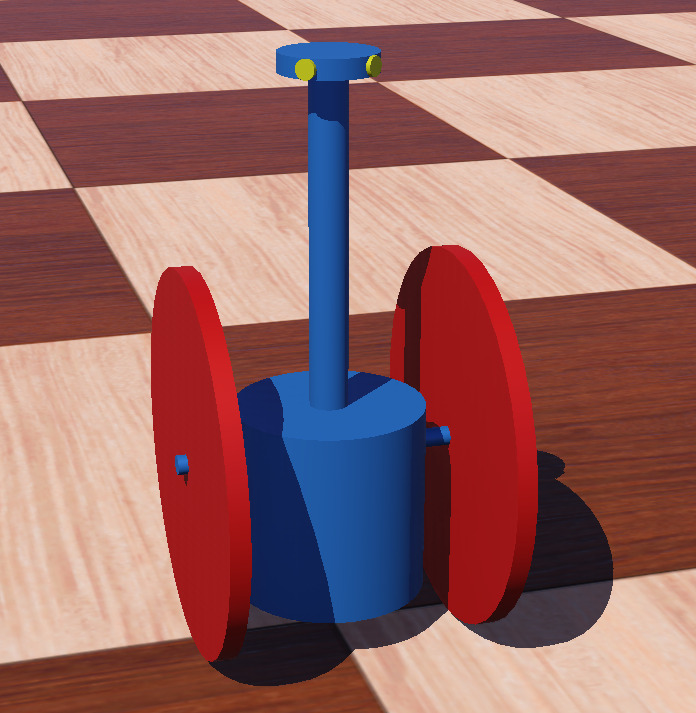
Screenshot of Webots model of a diff-drive ‘wobbly’ robot with low center of gravity.
System Kinematics and Components
The bodies are as follows:
name |
color |
notes |
|---|---|---|
body |
blue |
the core solid including counterweight, stalk, axle, and sensor disc |
left wheel |
red |
left wheel disc, cylinder with parameterized radius |
right wheel |
red |
right wheel disc, cylinder with parameterized radius |
The joints are as follows:
name |
parent |
child |
notes |
|---|---|---|---|
(6DOF free) |
world |
body |
mobile body; body +X axis is ‘forward’, +Z is ‘up’ |
left wheel |
body |
left wheel |
rotational joint on axle, parameterized Z position |
right wheel |
body |
right wheel |
rotational joint on axle, parameterized Z position |
The joint axes are as follows:
name |
direction |
notes |
|---|---|---|
left wheel |
along +Y |
along axle; direction chosen so positive rotation moves forward |
right wheel |
along +Y |
along axle; direction chosen so positive rotation moves forward |
The motors and sensors are named as follows:
name |
notes |
|---|---|
left wheel motor |
RotationalMotor on left wheel |
right wheel motor |
RotationalMotor on right wheel |
left wheel sensor |
PositionSensor on left wheel |
right wheel sensor |
PositionSensor on right wheel |
leftDistanceSensor |
DistanceSensor near top of body, aimed left of enter |
rightDistanceSensor |
DistanceSensor near top of body, aimed right of center |
gps |
GPS locator mounted on body in center of axle |
compass |
compass mounted on body in center of axle |
accelerometer |
three-axis accelerometer mounted on body in center of axle |
receiver |
radio Receiver |
emitter |
radio Emitter |
wobbly.proto
The robot model has been encapsulated in a .proto file for easy reuse. The model includes user-accessible scaling and color parameters.
  1#VRML_SIM R2025a utf8
  2# Two-wheeled differential-drive mobile robot with a low center of gravity.  The
  3# body is designed with enough ground clearance to tilt, but the low center of
  4# mass will wobble it back upright.  The body includes a mast with two distance
  5# sensors, a radio receiver and emitter, and a GPS receiver.  Each wheel has
  6# both a rotational motor and a position sensor. The shape is constructed
  7# entirely of primitive cylinders.
  8# documentation url: https://courses.ideate.cmu.edu/16-375
  9# license: No copyright, 2020-2026 Garth Zeglin.  This file is explicitly placed in the public domain.
 10# template language: javascript
 11PROTO wobbly [
 12  field SFVec3f    translation  0 0 0
 13  field SFRotation rotation     0 1 0 0
 14  field SFString   controller   "wobbly"
 15  field SFString   name         "Wobbly"
 16  field SFFloat    wheelRadius  0.1
 17  field SFFloat    axleLength   0.14
 18  field SFColor    bodyColor    0.0820075 0.364731 0.8
 19  field SFColor    wheelColor   1 0 0
 20  field SFString   customData   ""
 21]
 22{
 23  Robot {
 24    # connect properties to user-visible data fields
 25    translation IS translation
 26    rotation IS rotation
 27    controller IS controller
 28    name IS name
 29    customData IS customData
 30
 31    # calculate derived parameters
 32    %<
 33      let counterweightHeight = fields.wheelRadius.value
 34      let counterweightOffset = 0.75*fields.wheelRadius.value
 35      let counterweightTop    = 1.25*fields.wheelRadius.value
 36      let sensorHeight        = 3*fields.wheelRadius.value
 37      let stalkHeight         = sensorHeight - counterweightTop
 38      let stalkOffset         = counterweightTop + 0.5*stalkHeight
 39    >%
 40
 41    children [
 42      # The body group contains three cylinders: the massive counterweight at
 43      # bottom, a thin stalk rising above it, topped by the sensor disc.
 44      # All these shapes participate in collision; the axle is kept separate
 45      # as it is just for rendering.
 46      DEF bodyShape Group {
 47        children [
 48          # counterweight
 49          Transform {
 50            translation 0 0 %<= counterweightOffset >%
 51            rotation 1 0 0 0
 52            children [
 53              Shape {
 54                appearance DEF bodyAppearance PBRAppearance {
 55                  baseColor IS bodyColor
 56                  roughness 0.5
 57                  metalness 0.5
 58                }
 59
 60                geometry Cylinder {
 61                  height %<= counterweightHeight >%
 62                  radius 0.05
 63                }
 64              }
 65            ]
 66          }
 67  	  # sensor disc
 68          Transform {
 69            translation 0 0 %<= sensorHeight >%
 70            rotation 1 0 0 0
 71            children [
 72              Shape {
 73                appearance USE bodyAppearance
 74                geometry Cylinder {
 75                  height 0.01
 76                  radius 0.025
 77                }
 78              }
 79            ]
 80          }
 81	  # stalk
 82          Transform {
 83            translation 0 0 %<= stalkOffset >%
 84            rotation 1 0 0 0
 85            children [
 86              Shape {
 87                appearance USE bodyAppearance
 88                geometry Cylinder {
 89                  height %<= stalkHeight >%
 90                  radius 0.01
 91                }
 92              }
 93            ]
 94          }
 95        ]
 96      }
 97      # Visible axle shape, not part of the boundingObject.
 98      DEF axleShape Transform {
 99        translation 0 0 %<= fields.wheelRadius.value >%
100        rotation 1 0 0 1.5707963267948966
101        children [
102          Shape {
103            appearance USE bodyAppearance
104            geometry Cylinder {
105              height %<= fields.axleLength.value + 0.02 >%
106              radius 0.005
107            }
108          }
109        ]
110      }
111      # Define the left wheel axis, pointing in the +Y direction along the axle.
112      HingeJoint {
113        jointParameters HingeJointParameters {
114          axis 0 1 0
115          anchor 0 0 %<= fields.wheelRadius.value >%
116        }
117        device [
118          RotationalMotor {
119            name "left wheel motor"
120            acceleration 10
121            maxTorque 2
122          }
123          PositionSensor {
124            name "left wheel sensor"
125          }
126        ]
127	# Define the left wheel solid, offset along +Y along the axle.
128        endPoint DEF leftWheel Solid {
129          translation 0 %<= 0.5*fields.axleLength.value >% %<= fields.wheelRadius.value >%
130          rotation -1 0 0 1.5707963267948966
131          children [
132            # Define the left wheel shape and appearance, which is used by the right wheel solid.
133            DEF wheelShape Transform {
134              rotation 0 0 1 0
135              children [
136                Shape {
137                  appearance PBRAppearance {
138                    baseColor IS wheelColor
139                    roughness 0.5
140                    metalness 0.5
141                  }
142                  geometry Cylinder {
143                    height 0.01
144                    radius %<= fields.wheelRadius.value >%
145                  }
146                }
147              ]
148            }
149          ]
150          name "left wheel"
151          boundingObject USE wheelShape
152          physics DEF wheelPhysics Physics {
153            density 600
154          }
155        }
156      }
157      # Define the right wheel axis, also pointing in the +Y direction along the axle
158      # so positive wheel rotations will move forward.
159      HingeJoint {
160        jointParameters HingeJointParameters {
161          axis 0 1 0
162          anchor 0 0 %<= fields.wheelRadius.value >%
163        }
164        device [
165          RotationalMotor {
166            name "right wheel motor"
167            acceleration 10
168            maxTorque 2
169          }
170          PositionSensor {
171            name "right wheel sensor"
172          }
173        ]
174	# Define the right wheel solid, offset along -Y along the axle.
175	# The wheel shape is inherited from the left wheel.
176        endPoint DEF rightWheel Solid {
177          translation 0 %<= -0.5*fields.axleLength.value >% %<= fields.wheelRadius.value >%
178          rotation 1 0 0 1.5707963267948966
179          children [
180            USE wheelShape
181          ]
182          name "right wheel"
183          boundingObject USE wheelShape
184          physics USE wheelPhysics
185        }
186      }
187      # Define the two range sensors.  They are located on the sensor disc on
188      # top of the body stalk, each pointed off-axis by 1.0 radian.
189      DEF leftEyeSensor DistanceSensor {
190        translation 0.019 0.016 %<= sensorHeight >%
191        rotation 0 0 1 0.7
192        children [
193          DEF eyeShape Transform {
194            rotation 0 1 0 1.57
195            children [
196              Shape {
197                appearance PBRAppearance {
198                  baseColor 0.975691 0.981481 0.0252992
199                  roughness 0.5
200                  metalness 0.5
201                }
202                geometry Cylinder {
203                  height 0.004
204                  radius 0.005
205                }
206              }
207            ]
208          }
209        ]
210        name "leftDistanceSensor"
211        lookupTable [
212          0 0.025 0
213          1 1 0
214        ]
215        numberOfRays 2
216        aperture 0.4
217      }
218      DEF rightEyeSensor DistanceSensor {
219        translation 0.019 -0.016 %<= sensorHeight >%
220        rotation 0 0 1 -0.7
221        children [
222          USE eyeShape
223        ]
224        name "rightDistanceSensor"
225        lookupTable [
226          0 0.025 0
227          1 1 0
228        ]
229        numberOfRays 2
230        aperture 0.4
231      }
232      # add a default radio receiver and transmitter
233      Receiver {
234      }
235      Emitter {
236      }
237      # add a position-sensing 'GPS' device located at the center of the axle
238      GPS {
239        translation 0 0 %<= fields.wheelRadius.value >%
240      }
241      # add a rotation-sensing 'compass' returning only the X and Y components of the North vector
242      Compass {
243        zAxis FALSE
244      }
245      # add an accelerometer located at the center of the axle to measure both gravity and reactive forces
246      Accelerometer {
247        translation 0 0 %<= fields.wheelRadius.value >%
248      }
249
250    ] # close children list of Robot
251    boundingObject USE bodyShape
252    physics Physics {
253      density -1
254      mass 3
255    }
256  } # close Robot
257}
Sample Control Code
  1# wobbly.py
  2
  3# Sample Webots controller file for driving the wobbly diff-drive
  4# mobile robot.
  5
  6# No copyright, 2020-2026, Garth Zeglin.  This file is
  7# explicitly placed in the public domain.
  8
  9print("loading wobbly.py...")
 10
 11# Import the Webots simulator API.
 12from controller import Robot
 13
 14# Import standard Python libraries.
 15import math, random, time
 16
 17# Define the time step in milliseconds between controller updates.
 18EVENT_LOOP_DT = 200
 19
 20################################################################
 21class Wobbly(Robot):
 22    def __init__(self):
 23
 24        super(Wobbly, self).__init__()
 25        self.robot_name = self.getName()
 26        print("%s: controller connected." % (self.robot_name))
 27
 28        # Attempt to randomize the random library sequence.
 29        random.seed(time.time())
 30
 31        # Initialize geometric constants.  These should match
 32        # the current geometry of the robot.
 33        self.wheel_radius = 0.1
 34        self.axle_length  = 0.14
 35
 36        # Fetch handles for the wheel motors
 37        self.l_motor = self.getDevice('left wheel motor')
 38        self.r_motor = self.getDevice('right wheel motor')
 39
 40        # Adjust the low-level controller gains.
 41        print("%s: setting PID gains." % (self.robot_name))
 42        self.l_motor.setControlPID(1.0, 0.0, 0.1)
 43        self.r_motor.setControlPID(1.0, 0.0, 0.1)
 44
 45        # Fetch handles for the wheel joint sensors.
 46        self.l_pos_sensor = self.getDevice('left wheel sensor')
 47        self.r_pos_sensor = self.getDevice('right wheel sensor')
 48
 49        # Specify the sampling rate for the joint sensors.
 50        self.l_pos_sensor.enable(EVENT_LOOP_DT)
 51        self.r_pos_sensor.enable(EVENT_LOOP_DT)
 52
 53        # Connect to the eye sensors.
 54        self.l_eye_sensor = self.getDevice('leftDistanceSensor')
 55        self.r_eye_sensor = self.getDevice('rightDistanceSensor')
 56        self.l_eye_sensor.enable(EVENT_LOOP_DT)
 57        self.r_eye_sensor.enable(EVENT_LOOP_DT)
 58
 59        # Connect to the radio emitter and receiver.
 60        self.receiver = self.getDevice('receiver')
 61        self.emitter  = self.getDevice('emitter')
 62        self.radio_interval = 1000
 63        self.radio_timer = 0
 64        self.receiver.enable(self.radio_interval)
 65
 66        # Maintain a table of peer robot locations received over the radio.
 67        self.peers = {}
 68
 69        # Connect to the GPS position sensor.
 70        self.gps = self.getDevice('gps')
 71        self.gps_timer = 0
 72        self.gps_interval = 1000
 73        self.gps.enable(self.gps_interval)
 74        self.gps_location = [0, 0, 0.1] # reference pose value
 75
 76        # Connect to the compass orientation sensor.
 77        self.compass = self.getDevice('compass')
 78        self.compass_timer = 0
 79        self.compass_interval = 200
 80        self.compass.enable(self.compass_interval)
 81
 82        # State variables for reporting compass readings.  The heading is the
 83        # body forward (body +X) direction expressed in degrees clockwise from
 84        # North (world +Y).  The compass_vector is the direction of North
 85        # expressed in body coordinates.  The neutral pose points East.
 86        self.heading = 90
 87        self.compass_vector = [0,1] # reference pose value
 88        self.heading_error = 0
 89
 90        # Connect to the accelerometer sensor.
 91        self.accelerometer = self.getDevice('accelerometer')
 92        self.accelerometer_timer = 0
 93        self.accelerometer_interval = 200
 94        self.accelerometer.enable(self.accelerometer_interval)
 95        self.accel_vector = [0, 0, 9.81] # reference pose value
 96
 97        # Initialize generic behavior state machine variables.
 98        self.state_timer = 0        # timers in milliseconds
 99        self.state_index = 0        # current state
100        self.target_heading = 0
101        self.target_velocity = 0
102        return
103
104    #================================================================
105    # Polling function to process sensor input at different timescales.
106    def poll_sensors(self):
107
108        self.gps_timer -= EVENT_LOOP_DT
109        if self.gps_timer < 0:
110            self.gps_timer += self.gps_interval
111            location = self.gps.getValues()
112            if not math.isnan(location[0]):
113                self.gps_location = location
114                # print("%s GPS: %s" % (self.robot_name, location))
115
116        self.compass_timer -= EVENT_LOOP_DT
117        if self.compass_timer < 0:
118            self.compass_timer += self.compass_interval
119            orientation = self.compass.getValues()
120            if not math.isnan(orientation[0]) and not math.isnan(orientation[1]):
121                # For heading, 0 degrees is North, 90 is East, 180 is South, 270 is West.
122                # The world is assumed configured 'ENU' so X is East and Y is North.
123                # The robot 'front' is along body +X, so the neutral pose is facing East.
124                self.heading = math.fmod(2*math.pi + math.atan2(orientation[1], orientation[0]), 2*math.pi) * (180.0/math.pi)
125                self.compass_vector = orientation[0:2]
126                # print("%s Compass: %s, heading %3.0f deg" % (self.robot_name, self.compass_vector, heading))
127
128        self.accelerometer_timer -= EVENT_LOOP_DT
129        if self.accelerometer_timer < 0:
130            self.accelerometer_timer += self.accelerometer_interval
131            self.accel_vector = self.accelerometer.getValues()
132            # The accelerometer will read [0, 0, 9.81] when stationary in the reference pose.
133            # print("%s Accelerometer: %s" % (self.robot_name, self.accel_vector))
134
135        return
136
137    #================================================================
138    # Polling function to process radio and network input at different timescales.
139    def poll_communication(self):
140        self.radio_timer -= EVENT_LOOP_DT
141        if self.radio_timer < 0:
142            self.radio_timer += self.radio_interval
143            while self.receiver.getQueueLength() > 0:
144                packet = self.receiver.getString()
145                # print("%s Receiver: %s" % (self.robot_name, packet))
146                tokens = packet.split()
147                if len(tokens) != 5:
148                    print("%s malformed packet: %s" % (self.robot_name, packet))
149                else:
150                    name = tokens[0]
151                    if self.peers.get(name) is None:
152                        print("%s receiver: new peer observed: %s" % (self.robot_name, name))
153
154                    self.peers[name] = {'location' : [float(tokens[1]), float(tokens[2]), float(tokens[3])],
155                                        'heading'  : float(tokens[4]),
156                                        'timestamp' : self.getTime(),
157                                        }
158
159                # done with packet processing
160                self.receiver.nextPacket()
161
162            # Transmit a status message at the same rate
163            name_token = self.robot_name.replace(" ","_")
164            status = "%s %.2f %.2f %.2f %.0f" % (name_token, self.gps_location[0], self.gps_location[1],
165                                                 self.gps_location[2] - self.wheel_radius, self.heading)
166
167            # emitter requires a bytestring, not a Python Unicode string
168            data = status.encode()
169
170            # print("%s emitter: sending %s" % (self.robot_name, data))
171            self.emitter.send(data)
172
173    #================================================================
174    # motion primitives
175    def go_forward(self, velocity):
176        """Command the motor to turn at the rate which produce the ground velocity
177           specified in meters/sec.  Negative values turn backward. """
178
179        # velocity control mode
180        self.l_motor.setPosition(math.inf)
181        self.r_motor.setPosition(math.inf)
182
183        # calculate the rotational rate in radians/sec based on the wheel radius
184        theta_dot = velocity / self.wheel_radius
185        self.l_motor.setVelocity(theta_dot)
186        self.r_motor.setVelocity(theta_dot)
187        return
188
189    def go_rotate(self, rot_velocity):
190        """Command the motors to turn in place at the rate which produce the rotational
191           velocity specified in radians/sec.  Negative values turn
192           backward."""
193
194        # velocity control mode
195        self.l_motor.setPosition(math.inf)
196        self.r_motor.setPosition(math.inf)
197
198        # calculate the difference in linear velocity of the wheels
199        linear_velocity = self.axle_length * rot_velocity
200
201        # calculate the net rotational rate in radians/sec based on the wheel radius
202        theta_dot = linear_velocity / self.wheel_radius
203
204        # apply the result symmetrically to the wheels
205        self.l_motor.setVelocity( 0.5*theta_dot)
206        self.r_motor.setVelocity(-0.5*theta_dot)
207        return
208
209    def heading_difference(self, target, current):
210        """Calculate a directional error in degrees, always returning a value on (-180, 180]."""
211        err = target - current
212        # fold the range of values to (-180, 180]
213        if err > 180.0:
214            return err - 360
215        elif err <= -180.0:
216            return err + 360
217        else:
218            return err
219
220    def go_heading(self, target_heading):
221        """Rotate toward the heading specifed in positive degrees, with 0 at North (+Y),
222           90 at East (+X).  This assume the compass-reading process is
223           active."""
224
225        # find the directional error in degrees
226        self.heading_error = self.heading_difference(target_heading, self.heading)
227
228        # apply a linear mapping from degrees error to rotational velocity in radians/sec
229        rot_vel = 0.02 * self.heading_error
230        self.go_rotate(rot_vel)
231        # print("go_heading: %f, %f, %f" % (target_heading, self.heading, rot_vel))
232        return
233
234    def go_still(self):
235        """Actively damp any wobble to come to rest in place."""
236        # map an error in X acceleration to a linear velocity
237        vel = -0.05 * self.accel_vector[0]
238        self.go_forward(vel)
239        # print("go_still: %f, %f" % (self.accel_vector[0], vel))
240        return
241
242    #================================================================
243    def peer_heading_distance(self, record):
244        """Given a peer record, return a tuple (heading, distance) with the compass
245           heading and distance in meters of the peer from this robot current
246           location."""
247        loc = record['location']
248        dx = loc[0] - self.gps_location[0]
249        dy = loc[1] - self.gps_location[1]
250        distance = math.sqrt(dx*dx + dy*dy)
251        heading  = math.fmod(2*math.pi + math.atan2(dx, dy), 2*math.pi) * (180.0/math.pi)
252        return heading, distance
253
254    def nearest_peer(self, range=2.0):
255        """Locate the nearest peer (as reported by radio) within the given range.
256           Returns either None or a dictionary with the location record."""
257        result = None
258        best = math.inf
259        for name in self.peers:
260            record = self.peers[name]
261            heading, dist = self.peer_heading_distance(record)
262            if dist < best:
263                result = record
264                best = dist
265        return result
266
267    #================================================================
268    def poll_wandering_activity(self):
269        """State machine update function to aimlessly wander around the world."""
270
271        # This machine always transitions at regular intervals.
272        timer_expired = False
273        if self.state_timer < 0:
274            self.state_timer += 3000
275            timer_expired = True
276
277        # Evaluate the side-effects and transition rules for each state.
278        if self.state_index == 0:
279            print("Init state, entering cycle.")
280            self.state_index = 1
281
282        elif self.state_index == 1:
283            self.go_forward(0.2)
284
285            if timer_expired:
286                self.state_index += 1
287
288        elif self.state_index == 2:
289            self.go_heading(self.target_heading)
290
291            if timer_expired:
292                self.state_index += 1
293
294        elif self.state_index == 3:
295            self.go_still()
296
297            if timer_expired:
298                self.state_index += 1
299
300        elif self.state_index == 4:
301            self.go_rotate(math.pi / 6)
302
303            if timer_expired:
304                self.state_index = 1
305                self.target_heading = random.randint(0,360)
306
307        else:
308            print("%s: invalid state, resetting." % (self.robot_name))
309            self.state_index = 0
310
311        if timer_expired:
312            print("%s: transitioning to state %s" % (self.robot_name, self.state_index))
313
314        return
315
316    #================================================================
317    def poll_following_activity(self):
318        """State machine update function to always move toward the nearest peer."""
319
320        if self.state_timer < 0:
321            self.state_timer += 1000
322
323            # periodically test if there is a nearby peer
324            nearest = self.nearest_peer()
325            if nearest is None:
326                self.state_index = 1
327            else:
328                self.state_index = 2
329                heading, distance = self.peer_heading_distance(nearest)
330                self.target_heading = heading
331                self.target_velocity = 0.1 * distance
332                print("%s: peer to follow at %f deg, %f meters" % (self.robot_name, heading, distance))
333
334        # always either stabilize, turn, or move
335        if self.state_index < 1:
336            self.go_still()
337
338        else:
339            heading_err = self.heading_difference(self.target_heading, self.heading)
340            if abs(heading_err) > 20.0 or abs(self.target_velocity) < 0.05:
341                self.go_heading(self.target_heading)
342            else:
343                self.go_forward(self.target_velocity)
344
345    #================================================================
346    def run(self):
347        # Run loop to execute a periodic script until the simulation quits.
348        # If the controller returns -1, the simulator is quitting.
349        while self.step(EVENT_LOOP_DT) != -1:
350            # Read simulator clock time.
351            self.sim_time = self.getTime()
352
353            # Read sensor values.
354            self.poll_sensors()
355
356            # Check the radio and/or network.
357            self.poll_communication()
358
359            # Update the activity state machine.
360            self.state_timer -= EVENT_LOOP_DT
361
362            # This will run some open-loop motion.  One robot will be the leader, the rest will follow.
363            mode = self.getCustomData()
364            if mode == 'leader':
365                self.poll_wandering_activity()
366            else:
367                self.poll_following_activity()
368
369
370################################################################
371# Start the script.
372robot = Wobbly()
373robot.run()