Sewon Park – Final Project Proposal

I think art is inspiring as it serves as a versatile instrument where artists can communicate their beliefs and ideas to their viewers. Such message may be very personal such as the sentiment of happiness or sorrow or even socially conscious, trying to bring about changes that the artist believes in.
Such socially conscious art projects are valuable as it finds an easy way to communicate messages to the public. Not only is it easier to understand, such projects tend to resonate with the audience if interesting.

As such, I decided to go ahead with Professor Dannenberg’s suggestion to make a project with the theme of global warming. My previous blog posts had two global warming projects with vastly different ways of communicating the message. In my project, I will use both sympathy and entertaining interaction to communicate my message.

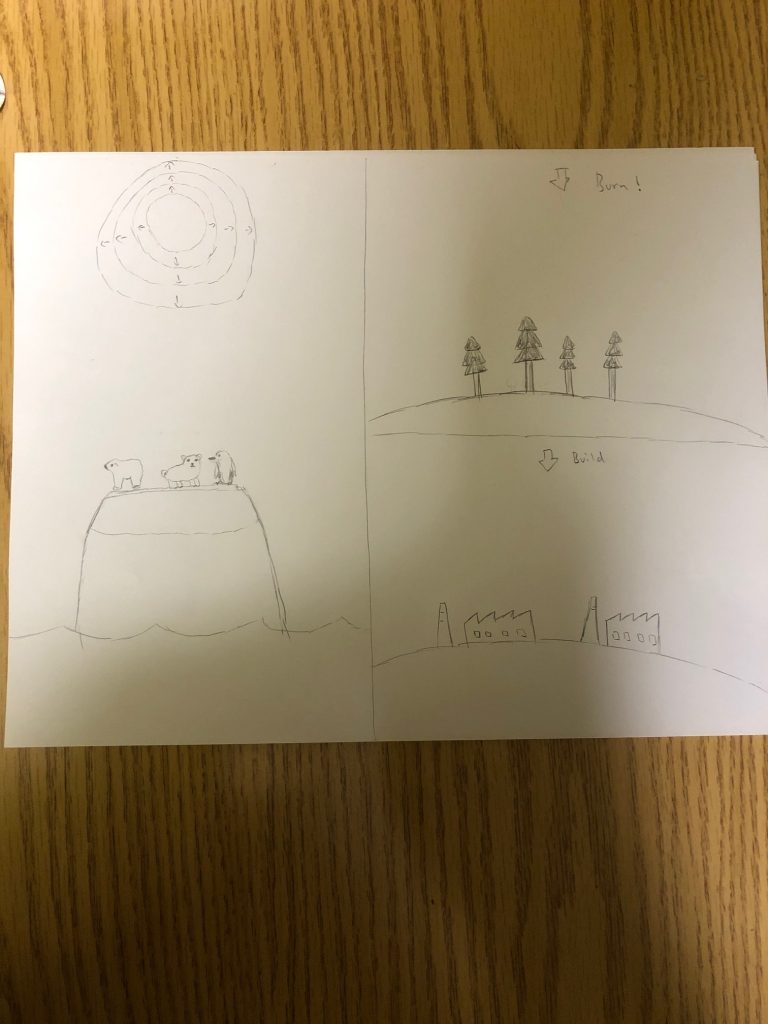
In order to clearly depict the how the wrongdoings of human beings are causing climate change, I will reserve one section of the project where the user can add pollution to the atmosphere through the destruction of trees and creation of factories. As the number of factories grow, the sun on the right hand side to grow bigger causing the ice caps to melt until the bears and penguins eventually submerge.

The point of the project is to portray that our own actions can cause global warming and cause the poor animals to die. Through interesting interaction and pity felt during this “game”, I hope that my message will reach its audience.
Jasmine Lee – Looking Outwards – 12

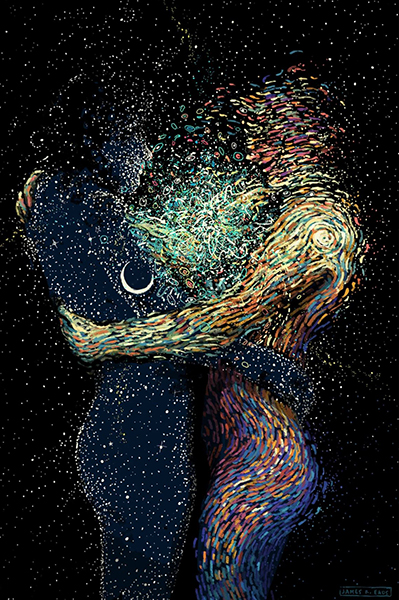
The first precedent I found for my final project is Goodbye, Helios, an art piece by James R. Eads. The artwork is a digital piece drawn by Eads on a graphic tablet. It depicts the story of the relationship between two characters, Night, and Helios. Goodbye, Helios was one of the projects animated in a collaboration between Eads and Chris McDaniel (an animator known as “The Glitch”). I really enjoy the visuals used in the animations, from the bright, varied colors, to the smooth flowing movement of the lines. This is something that I would like to try and incorporate into my final project.

Eads’ Goodbye, Helios artwork, depicting Helios burning out.

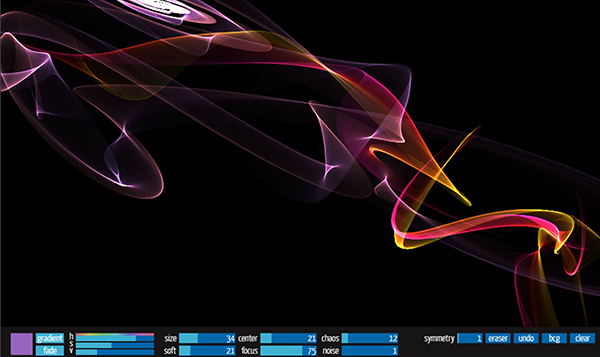
The second project I found as a precedent for my final project is Flame Painter, which is a painting software created by Escape Motions. It makes use of particle systems in order to allow the user to create incredibly dynamic and fluid brush strokes. The software is available to purchase for the use of different artistic professions, but for the purpose of this Looking Outwards, I interacted with the free demo. I enjoyed the way that the brush follows the mouse cursor, and the way that it almost rotates around the chosen spot. Even though the mouse is stagnant, the brush remains rotating and moving around the cursor. This creates an interesting interaction for the user to try to manipulate.

A screenshot of an short interaction on FlamePainter.

Sean Meng-Looking Outwards-12

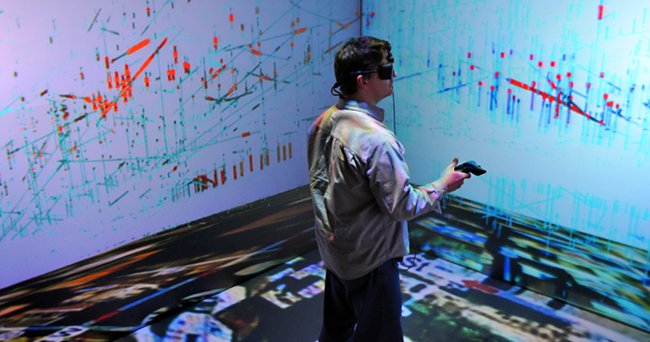
Both the projects below are sound visualization art projects and they intrigue me as transferring invisible elements to visible. Mark Hasegawa-Johnson and Thomas Huang of the Human-Computer Intelligent Interaction research theme led a collaboration that developed new computational methods for creating graphical visualizations of large audio files. The visualizations allow the user to scan an audio recording at 200 times that of real-time, enabling them to discover unexpected, or anomalous, events.

Using an analogy to items sometimes hidden in video games by manufacturers called “Easter eggs”, the researchers employed the term to refer to these unexpected events. Hasegawa-Johnson said the software is designed to free up the analyst by having the computer perform certain tasks, and render the data visually, such as with a spectrogram. The technology is able, for example, to analyze thousands of sound sources in an urban environment

The Cube: visualization of an audio dataset in the 3-D virtual environment
Link: https://beckman.illinois.edu/news/2011/11/visualizingsound

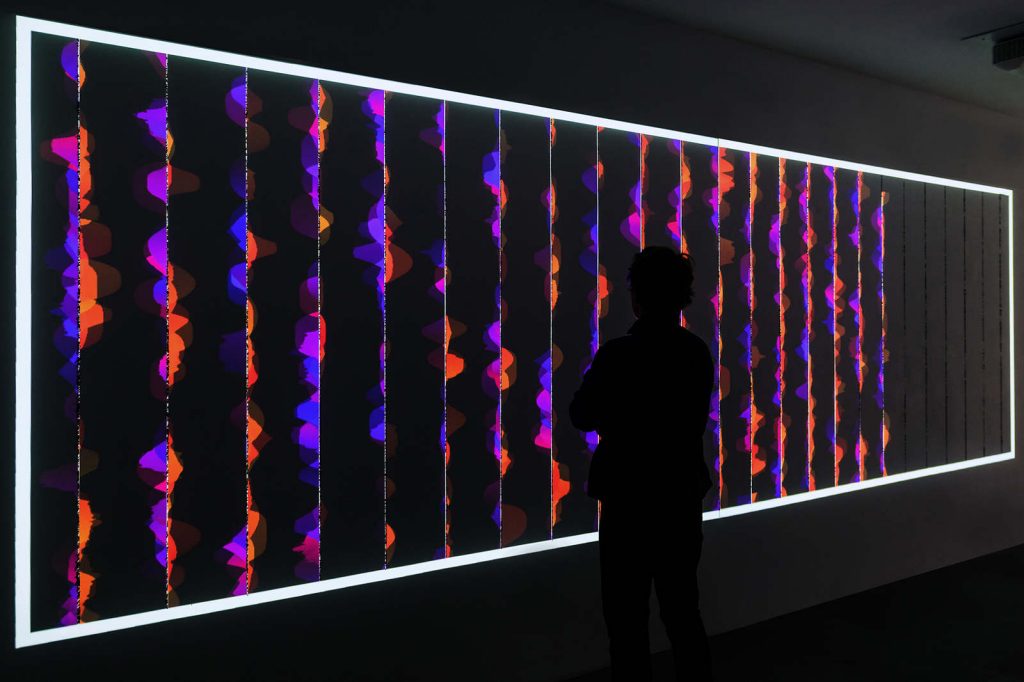
News Feed is a data visualization and sound art installation that reads major worldwide online newspapers, exposing the sentiment of news stories published. As new articles are published from major journals, VADER algorithm analyses and classifies them according to whether they are positive or negative in sentiment. These results are then interpreted and transformed into sound and visual meanings, making the audiovisual installation to perform accordingly with the data.

”NEWS FEED”, 2019
Link: https://rudolfoquintas.com/News-Feed

Yoshi Torralva – Project 12 – Proposal

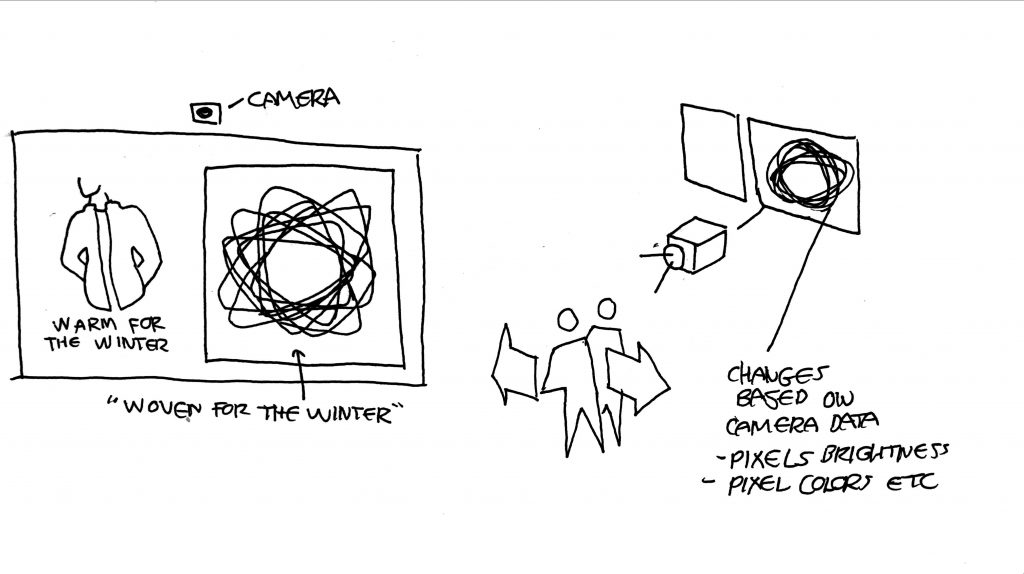
For my final project, I’m interested in exploring the opportunities in interactive advertising. Over the past decade, advertising has changed drastically from paper ads, social media posts, and now, more recently, interactive environments. As we approach winter, I wanted to focus on winter clothing and how I can manifest the textiles to be interactive to people passing a storefront. To achieve this, I plan on using the input from the camera do adjust a curve(s) on the screen. I plan on comparing pixels from the camera to determine specific actions that the curve takes. The actual output from the camera will not be used and will be layered over by a blank canvas, and the type of curve I decide to choose. To show the advertisement in action, I plan on placing the ad in a storefront mockup to support the posted WordPress file. Overall, I’m quite excited to understand how to use camera data to engage the audience.

Sarah Kang – Project Proposal

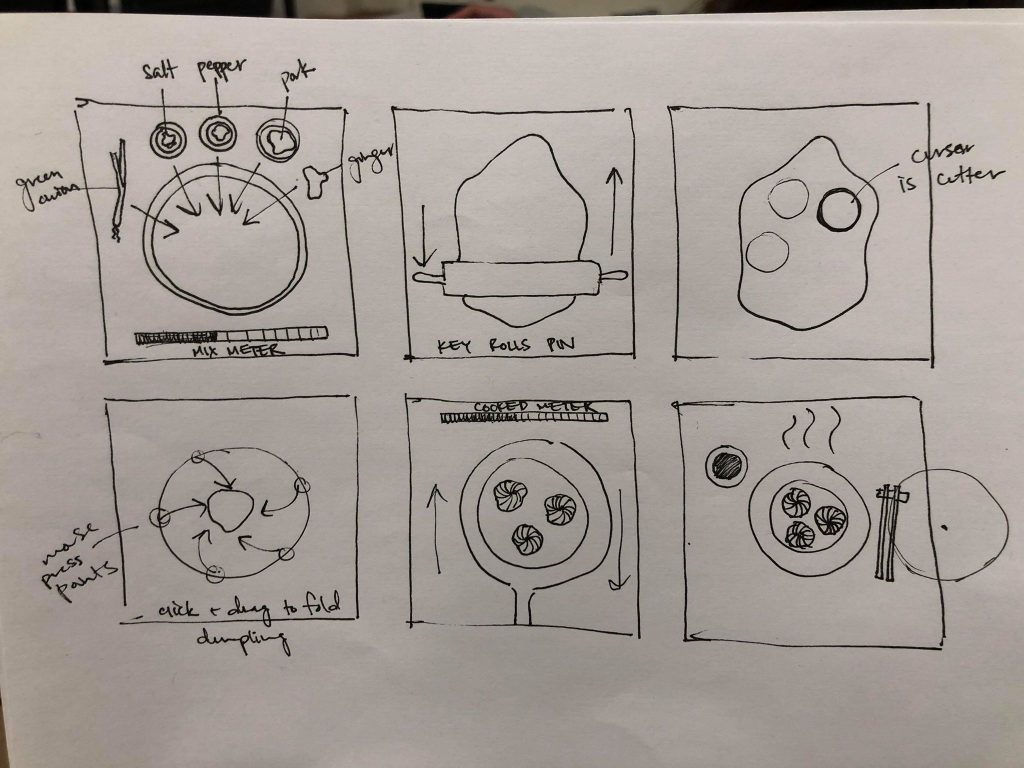
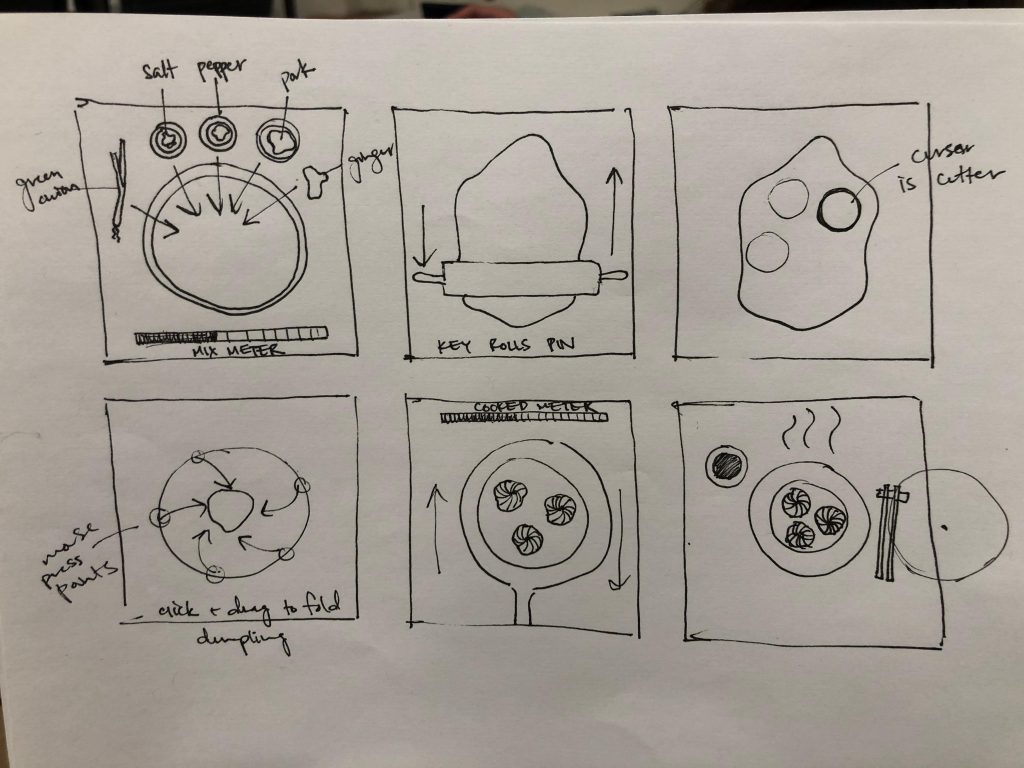
For this final project, I will be collaborating with Kimberlyn Cho to create an interactive dumpling making game. We were inspired by the game, cooking mama, and wanted to recreate something similar in the form of an interactive storyboard going through the steps of making dumplings. So far, we have tentatively six boards planned out with interactive actions involving keys, mouse press and mouse drag and some ideas for how we’d want to illustrate the scenes, either with imported images or some coded graphics. We also plan to add more interaction through speed, drag, and meter gauges to engage the user and make a fun experience.

Kimberlyn Cho- Project 12- Proposal

I will be working with Sarah Kang for the final project to create an interactive cooking software that makes dumplings. While considering the various types of foods to make, we decided to make dumplings because we found many interactive aspects in the dumpling making process that we hope to incorporate in our project. There are 6 stages to the game with user interactions for each stage besides the final plating. We simplified the process into mixing the ingredients, rolling the dough, cutting the dough, folding the dumpling, frying the dumpling, and the final plating of the finished dumplings.

We will be using imported images we find online with images we code directly on p5js, as well as images we draw on illustrator and import to animate the game. The user will be able to interact with the game using the mouse cursor as well as specific keys such as the space bar.

storyboard

Steven Fei & Mike Jin-Project 12-Proposal


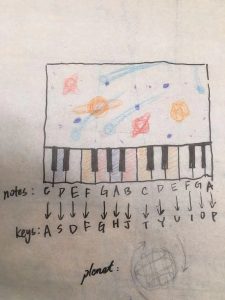
For this project, We are going to create a scene with the theme of an interstellar pianist. The background will be a 3D view of the galaxy and the viewport will be manipulated through changing the mouse position. The foreground will be an array of piano keys that can be connected by the keyboards. Once a short tune is played, a star is given birth. There can be a maximum amount of the stars. Once the maximum is reached, the oldest star will be eliminated. The stars that are given birth to will be presented in a 3D form and different colors to differentiate from the galaxy in the background. Depending on the different tunes that the user played, different type of stars can be generated.

Proposal Image, An interstellar Pianist

Nadia Susanto – Looking Outwards – 12

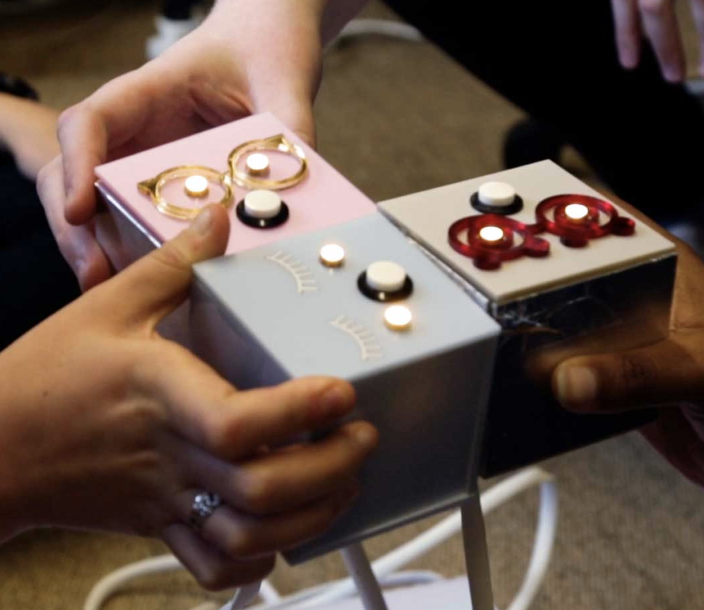
I wanted to look at Phoenix Perry and Heather Kelley because they are both game developers. Phoenix Perry created a game called Bot Party where it explores intimacy through physical play using sound. It’s an interactive sound experience for humans and the bots need help from humans to communicate with their friends. The technology itself uses proprietary bot to skin to skin to bot communication protocol to send encoded secret messages.

Phoenix explaining her game and why she made it
Closer look into the aspect of the game where the bots have to touch each other

Heather Kelley collaborated with several others on the project Fabulous/Fabuleux. It is a physical interface game for public interior spaces where players solve “connect the dots” challenges using the hotspots of the room. The players uses a “squisher” interface object and by connecting the hotspots it reveals objects on screen which relate to the fairy tale “The Girl Who Trod On A Loaf.”

Video demonstrating the game being played

Both of these games interest me because they require physical human interaction within it. I will be doing a project that requires human interaction, so I was inspired by these projects.

To learn more about bot party click below:

http://playbotparty.com/2018/01/24/WhatIsBotPartyl-prep/

To learn more about Fabulous/Fabuleux click below:

http://www.perfectplum.com/portfolio/fabulousfabuleux/

Katrina Hu – Looking Outwards – 12

Project Priors and Precursors

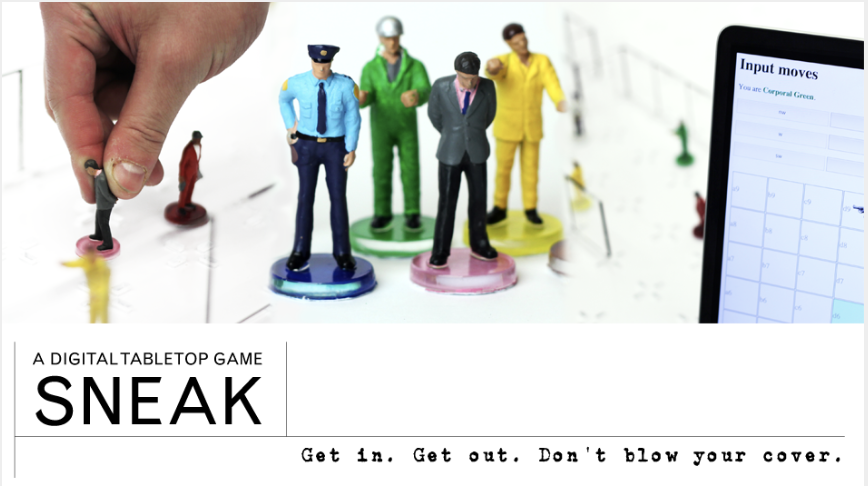
A sample of Greg Borenstein’s game “Sneak

The first artist I researched was Greg Borenstein. Greg Borenstein is a game designer, technologist, and teacher. His work explores game design, computer vision, drawing, machine learning, and generative storytelling as media for play and design. His game “Sneak” is a hybrid digital-physical tabletop game that began as his thesis in the MIT Media Lab Playful Systems group. It attempts to combine the social richness of a boardgame with the systemic complexity of a video game. This is relevant to my final project because I also would like to make an interactive game.

A demonstration of the GROW screencast

The second work I looked at was Moritz Stefaner’s “GROW Soil Moisture Maps.” The GROW Observatory is a European-wide project engaging thousands of growers, scientists and others passionate about the land. They developed the Dynamic Soil Moisture Map as a demonstration of an information service which could be used by farmers, scientists and policy makers for applications in agriculture and climate forecasting. These maps use GROW sensor data combined with satellite data to generate a continuous estimation of water content over a terrain. I admire how they look at real world data. This relates to my final project because it is also about the environment and the wellbeing of the earth.

Katrina Hu – Project 12 – Proposal

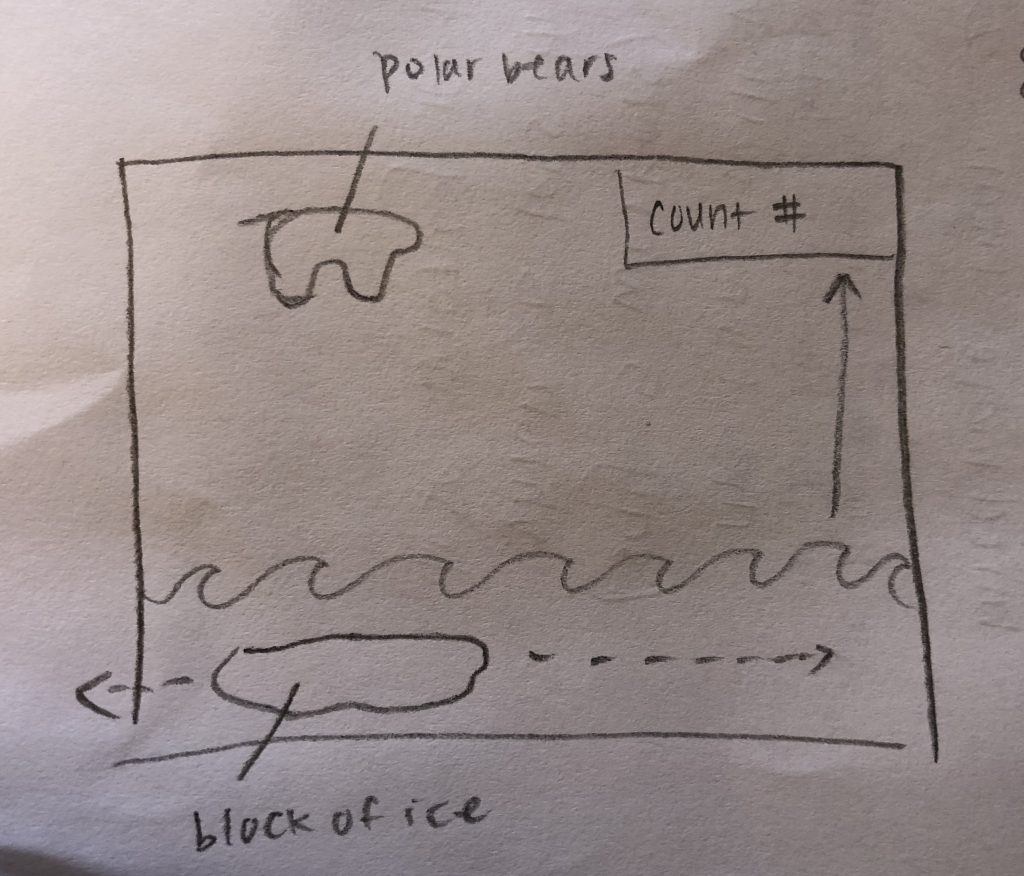
I will be collaborating with Chelsea Fan for Project 12. We plan to create a fun game relating to climate change. The objective of the game is to catch little polar bears that are falling. To do this, the user will slide a block of ice back and forth at the bottom of the screen. If the polar bear is caught with the block of ice, a positive tone will ring. If the user is unable to catch the polar bear, it will fall into water and a negative tone will ring.

We will also keep a number tally of all the polar bears that are caught and that drown. Every time a polar bear isn’t caught an drowns, the water level a small amount. The game is over when the water level reaches the top of the screen.

To make the game more challenging, we will also have two sizes of polar bears. Small baby polar bears will fall at a faster speed than the larger polar bears.

Simple drawing of our game