dnam-Looking Outwards-06

Mark Wilson – ‘e4708’

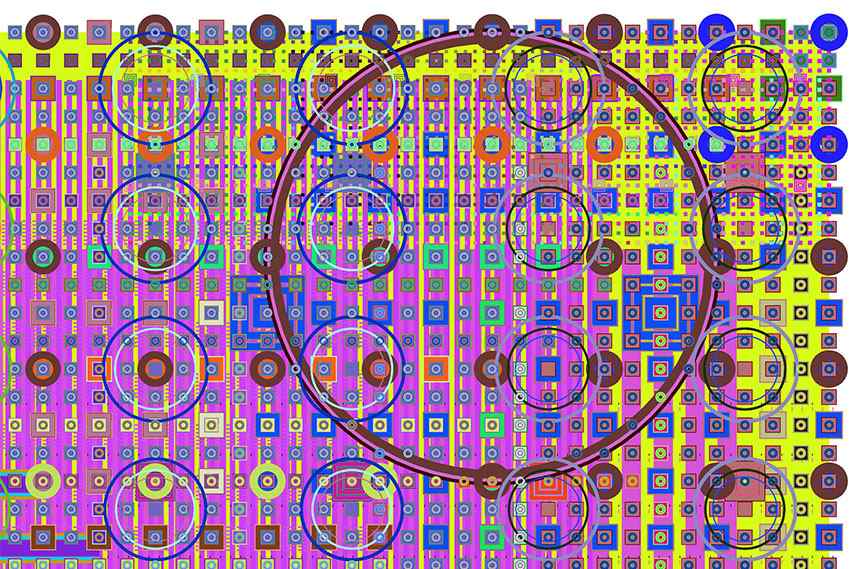
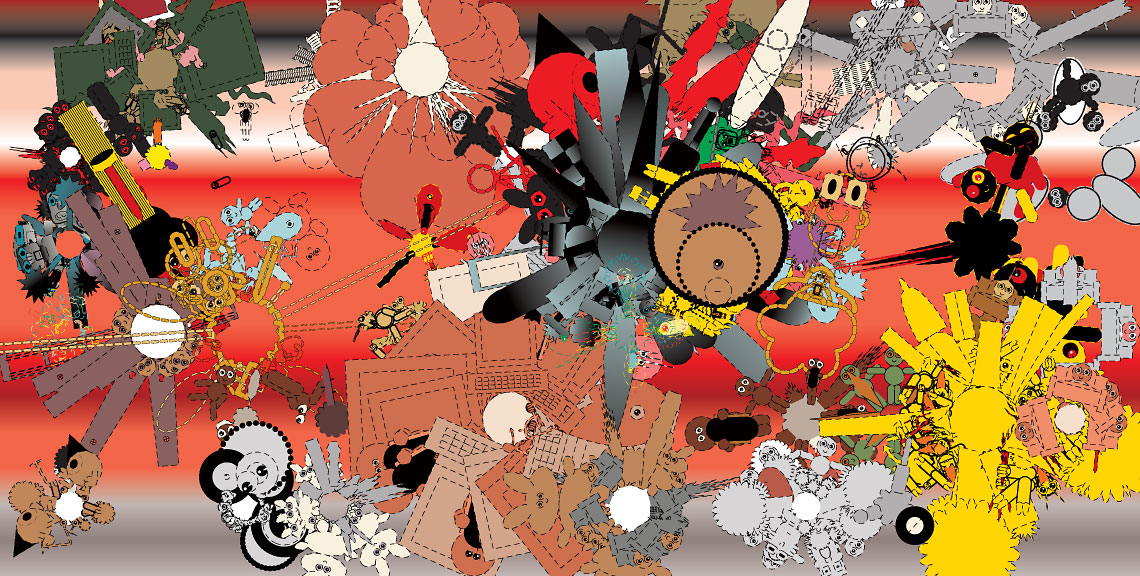
With computer generated arts becoming more prevalent, artists haave leaned on photo editing and codes to create new artworks. Another new tool is algorithms – where artists borrow the computer’s ability to generate ‘random’ number plugs to create different shapes, forms, colors in different areas of the digital canvas. Mark Wilson is an artist that very much utilizes the random generation from the computer to create similar, yet different artworks everytime. There is an issue of question if these artworks are truly random as Wilson is virtually telling the computer to pick a number out of the options. However, one thing is for sure, Wilson’s artworks are an interesting showcase of modern art technology. More of his works can be found here.

ljkim looking outward 06


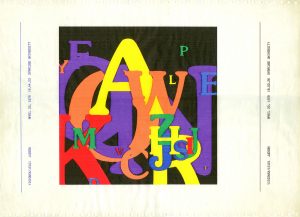
“Letter Field” by Judson Rosebush

This piece is called “Letter Field” by Judson Rosebush. I really appreciate this piece because it uses a software to generate the art. Meanwhile, I feel like it follows communication design guidelines. I’m assuming that this piece had to be generated several times in order for one to look like an actual piece of designed work. It works by through a database of the Souvenir font; random number generation, a statistical basis to determine letter size, color, and position; and a hidden line algorithm all combine to calculate this scan line raster image. I believe that the letters are randomly generated and also with the size and color.

mjnewman Project-06, Section A

sketch

var canvasWidth = 240;
var canvasHeight = 480;

function setup() {
    createCanvas(canvasWidth, canvasHeight);
}

function draw() {
	//movement of minute, second, and hour ellipses
	var sec = map(second(), 0, 59, 10, height - 10);
	var min = map(minute(), 0, 59, 30, width - 30);
	var hr = map(hour(), 0, 23, 50, height - 50);
	//adding hour variable so that there is a dynamic background
	background(20, 30, hr/6);
	noStroke();
	//hour cirlce moves up and down the canvas, color also changes depending on the hour
	fill(40, 160, hr/2);
	//largest circle
	ellipse(width/4, hr, 100, 100);
	//minutes circle moves across the canvas, color changes depending on minute
	fill(130, 209, min);
	//middle sized circle
	ellipse(min, height * 0.75, 60, 60);
	//seconds circle moves down the canvas, color changes depends on the second 
	fill(200, sec/2, 90);
	//smallest circle
	ellipse(width / 2, sec, 20, 20);

}

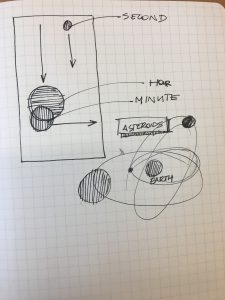
For my initial idea, I wanted to mimic how the interaction of asteroids and planets in our solar system. I wanted to illustrate how asteroids get uncomfortably close to these planets, hence the distance between the second and hour circles. There have been many documented close calls that are visible on Youtube.

In terms of colors, I wanted to mimic the impact that asteroids experience when the enter the atmosphere, hence the changing of color from pink to yellow. The rest of the circles change color in order to have a dynamic clock. The background will stay relatively dark to mimic the color of “space.”

LookingOutwards-06

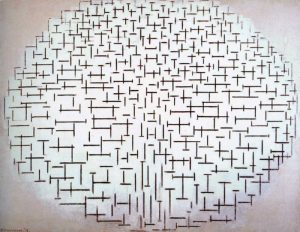
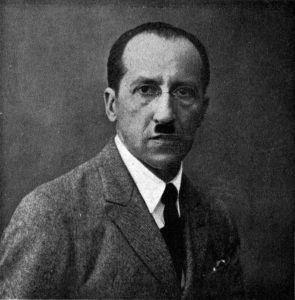
For this week’s looking out post, I decided to use Piet Mondrian’s piece: Composition No. 10 Pier and Ocean, created in 1915.

The inspiration behind this piece was the rhythms created by the waves in the ocean hitting and splashing against pier. However, he uses a randomness to illustrate the rhythm and feel of the pier and ocean. From first impression, one would view Mondrian’s piece as a very random, abstract piece. In reality, the “randomness” behind his work is a very calculated randomness.

Mondrian considered art as a reflection of the spirituality of nature. By creating artwork that was stripped down to the very basics, he hopes to show the energy and balance of the forces in nature. He used simple vertical and horizontal shapes to represent the positive and negative universal energies. Every line and space in his works is carefully placed to reflect the energies of nature and recreate the balance in a visual form.

http://www.piet-mondrian.org/pier-and-ocean.jsp

sunmink-project06-Abstract Clock

sketch

//SunMin Kim 
//Section E
//sunmink@andrew.cmu.edu
//Project 06 

function setup() {
    createCanvas(480, 480);
}

function draw() {
    //show the current time 
    var h = hour(); 
    var m = minute(); 
    var s = second(); 
    
    //color of the ocean changes depending on hours 
    var mapH = map(h, 0, 25, 0, 255);
    background(mapH, 220, 250); 

    noStroke();
    //tail 
    fill(230, 150, 70);
    rect(365, 270, 80, 100, 40, 20, 20, 40);
    //body
    fill(230, 150, 70);
    rect(50, 230, 320, 180, 20, 20, 20, 20);
    //eyes 
    fill(255); 
    ellipse(120, 300, 50, 50);
    //pupill
    fill(0);
    ellipse(122, 292, 30, 30);
    //bubble1
    fill(255);
    ellipse(110, 50, 20, 20);
    //bubble2
    fill(255);
    ellipse(105, 160, 20, 20);
    //bubble3
    fill(255);
    ellipse(130, 110, 20, 20);


    //changes form 24 hour to 12 hour clock 
    if (h == 0){ 
        h = 12; 
    } else if (h > 12 & h < 24){ 
        h -=12; 
    } else{ 
        h = hour(); 
    }
   
    //draw hair every second 
    for (var c = 0; c <= s; c++){
        strokeWeight (2.5); 
        stroke(255); 
        line(80 + 6 * c, 190, 63 + 5 * c, 230);
    }

    //size of mouth gets larger depending on the minutes
    var mapM = map(m, 0, 100, 0, width); 
    noStroke(); 
    fill(230, 80, 100);
    rect(50, 350, mapM, 50, 5, 5, 5, 10);
  
    fill(0);
    textSize(8);
    text( h + " hour(s) " + m + " minute(s) " + s + " second(s) ", 20,20);
}


After finishing assignments using index variables, I was excited to create an abstract clock that transforms according to hours, minutes, and seconds. Thus for the abstract clock, I wanted to take benefit of making a clock that is interesting to watch more than few seconds.  Throughout this project, I struggled the most when coming up with triangle coordinates. I feel good with the outcome that I successfully used triangles for this wallpaper which was the most challenging part during the project.

Throughout this project, I struggled the most to come up with types of design that allows me to indirectly display the time flow. However, I felt great to successfully use different parts in the fish to represent the time flow.

mecha-lookingoutwards-06


Coding Architecture

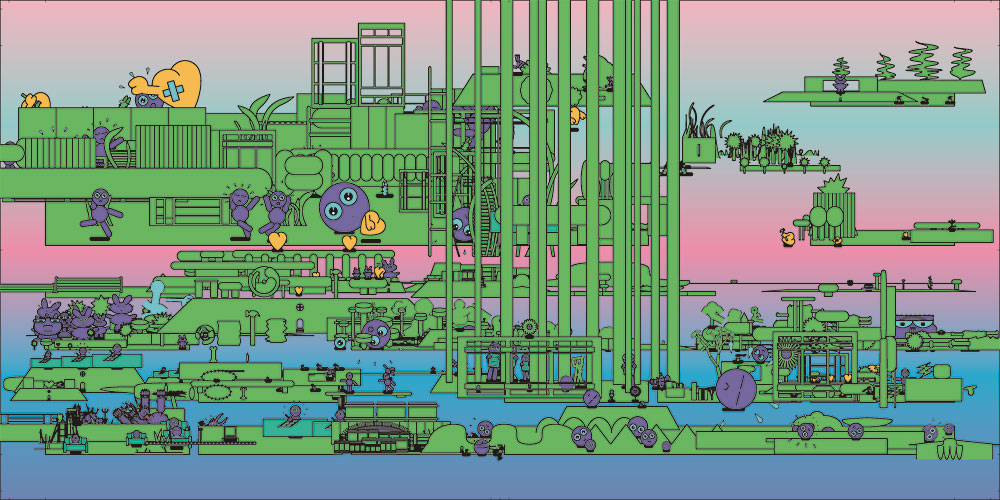
For this week, I stumbled upon the artwork of Linyi Dai, a graduate of Rhode Island School of Design. When I first considered the subject of randomness in computational art, I did not even consider the possibility of using randomness in order to produce practical objects. While this example may not be a perfect example of practicality, it led me to realize that randomness could be used for things such as architectural rendering. While there are a lot of conditions for this specific example of randomness, the location of where the rectangles appear on each of the layers on this piece are. What I found to be particularly inspiring about this piece was Dai’s ability to create spheres that followed a similar format while still displaying a nature of randomness. I liked that the changes between each sphere were subtle yet undeniably there.

myoungsh-project-06-abstract-clock

sketch

//Mason Young-Shor 
//Section C 
//myoungsh@andrew.cmu.edu 
//Abstract Clock
function setup() {
  createCanvas(600, 600);
  background(0);
}
function draw() {
  background(0);
  angleMode(DEGREES);
  var h = hour();
  var m = minute();
  var s = second();
  if (h > 12) { //12 hour clock
    h -= 12;
  }
  for (var H = 1; H < h + 1; H ++) { //hour indicatior
    var x = 0;
    var y = 0;
    push();
    translate(300, 300);
    rotate(180);
    rotate(30 * H);
    if (H % 3 === 0) { //every three hours is big and white
      stroke(256);
      fill(256);
      x += 15;
      y += 5;
    } else { //the rest are small and yellow
      stroke(256, 256, 0);
      fill(256, 256, 0);
    }
    line(0, 0, 0, 110 + x);
    ellipse(0, 110 + x, 10 + y, 10 + y);
    pop();
  }
  for (var M = 1; M <= m; M ++) { //minute indicator
    x = 0;
    y = 0;
    push();
    translate(300, 300);
    rotate(180);
    rotate(6 * M);
    if (M % 5 === 0) { //every five minutes is big and white
      stroke(256);
      fill(256);
      x += 15;
      y += 5;
    } else { //the rest are smal and yellow
      stroke(256, 256, 0);
      fill(256, 256, 0);
    }
    line(0, 0, 0, 170 + x);
    ellipse(0, 170 + x, 10 + y, 10 + y);
    pop();
  }
  for (var S = 1; S <= s; S ++) { //second indicator
    x = 0;
    y = 0;
    push();
    translate(300, 300);
    rotate(180);
    rotate(6 * S);
    if (S % 5 === 0) { //every five seconds is big and white
      stroke(256);
      fill(256);
      x += 15;
      y += 5;
    } else { //the rest are small and yellow
      stroke(256, 256, 0);
      fill(256, 256, 0);
    }
    line(0, 0, 0, 230 + x);
    ellipse(0, 230 + x, 10 + y, 10 + y);
    pop();
  }
}

selinal-Looking-Outwards-06

Pound Art  Comics by John Pound

http://www.poundart.com/art/randcomix/about.html

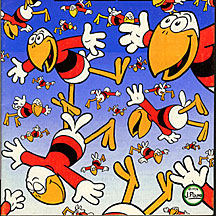
John Pound uses his self-developed software to create comics or 2D works derived off of randomization of visual elements. His development of his practice and view of his programs is interesting in that he uses programs “not as a passive tool, like an airbrush, but as an active partner in making creative decisions” (Pound). I appreciate the abstraction and subjectivity of computing in this manner. While the random visuals produced look as if they were just performed by a random function in a 2D coordinate plane, Pound keeps the fabrication of his code and software to himself but says it is coded in PostScript. The visuals look as if there is a constant and a constraint of variables with a simple random variable to add variation. That way, there is a consistency in characters/characteristics but a slight change in illustration that adds presence and personality.

Image result for pound art

Image result for pound art

Image result for john pound comic


mmiller5-Looking Outwards-06


Performance of John Cage’s “Inlets”

“Inlets” is a non-deterministic chance composition composed by John Cage in 1977.  In it, there are three players who hold conch shells of varying sizes filled with water.  By tipping the shells back and forth, it is possible to form bubbles that make a gurgling sound; however, the formation of bubbles is random, causing the piece to be non-deterministic and chance based.  To remove the preferences of the players from the performance, John Cage utilized the novelty of conch shells as an instrument (something the players would have minimal preferences with), helping to ensure that the composition would be more contained and chance based.  I admire John Cage’s re-envisioning of music, that it doesn’t have to be fixed each time that it’s played.  Following the same algorithm for production leads to performances that have the same essence but different products, which I find to be really neat.

rfarn -Project-06-AbstractClock

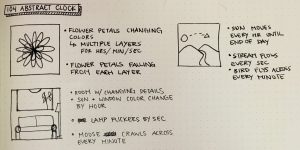
For this project, it took me a while to figure out what I wanted to do. At first I was stuck on the idea of a clock being circular and thought of creating a flower with petals to represent hours, minutes and seconds. However, I thought this wasn’t abstract enough. After pondering for a bit, I came up with the idea of creating a landscape with certain parts that would gradually change over time. At first, I thought of just creating a natural landscape with a sun, river, and mountains, but I felt this wasn’t personalized enough.
While thinking of what to do, I was siting at my kitchen table staring at the couch across from me and out my window. I finally decided to take inspiration from my own room and create an image of this view of the room. I decided to add a few different fun features to the actual clock.
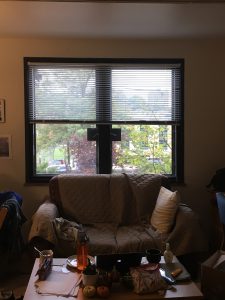
In the abstract clock, the light turns on and off by the second, the sky and sun shift by the hour, and the mouth of the couch gradually opens by the minute.

sketch

function setup() {
    createCanvas(480, 400);
}

function draw() {
	background(164, 158, 141);
	var h = hour();

//window assembly
	var windowM = 80; //margins on sides of window (distance from edge of canvas to edge of window)
	var windowW = 320; //width of window
	var windowH = 240; //height of window
	
	if(h > 0 & h < 13){ //sky brightens from 1am - 12pm
		var skyR = h * (167/12); //red
		var skyG = h * (206/12); //green
		var skyB = h * (214/12); //blue
	} else { //sky darkens from 1pm - 12am
		var skyR = 167 - (h - 12) * (167/12); //red
		var skyG = 206 - (h - 12) * (206/12); //green
		var skyB = 214 - (h - 12) * (214/12); //blue
	}

	//window
	noStroke();
	fill(skyR, skyG, skyB);
	rect(windowM, 0, windowW, windowH);
	strokeWeight(10);
	stroke(60, 61, 59);
	line(windowM, 0, windowM, windowH); //left border
	line(windowM + windowW, windowH, windowM + windowW, 0); //right border

	//sun
	var sunDiam = 100; //diameter of sun
	var sunX = width/2; //x position of sun

	if(h > 0 & h < 13){ //sun rises from 1am-12pm
		var sunY = (windowH + sunDiam/2) - h * ((windowH + sunDiam)/12);
	} else { //sun lowers from 1pm-12am
		var sunY = -sunDiam/2 + (h - 12) * ((windowH + sunDiam)/12); //y position of sun
	}
	
	if(h > 0 & h < 13){ //sun brightens from 1am-12pm
		var sunR = h * (211/12); //red
		var sunG = h * (130/12); //green
		var sunB = h * (115/12); //blue
	} else { //sun darkens from 1pm-12am
		var sunR = 211 - (h - 12) * (211/12); //red
		var sunG = 130 - (h - 12) * (130/12); //green
		var sunB = 115 - (h - 12) * (115/12); //blue
	}

	noStroke();
	fill(sunR, sunG, sunB);
	ellipse(sunX, sunY, sunDiam, sunDiam);

	
//couch
	var couchR = 228; //couch red
	var couchG = 231; //couch green
	var couchB = 189; //couch blue
	var cushionW = 180 - minute() * (140/60); //changing width of cushion
	var cushionR = 240 + minute() * (140/60); //changing x position of right cushion

	strokeWeight(5);
	stroke(couchR - 10, couchG - 10, couchB - 10);
	fill(couchR, couchG, couchB);
	rect(60, windowH - 10, 360, height - windowH + 10, 40);	//back of couch
	
	//couch face
	noStroke();
	fill(211, 130, 115);
	rect(60, windowH + 65, 360, 75); //mouth gums
	strokeWeight(30);
	stroke(261, 80, 65);
	line(120, 345, 360, 345); //mouth
	fill(255);
	noStroke();
	rect(210, 330, 20, 20); //tooth right
	rect(250, 330, 20, 20); //tooth left
	ellipse(140, 270, 30, 40); //eye white left
	ellipse(340, 270, 30, 40); //eye white right
	fill(0);
	ellipse(340, 275, 20, 20); //pupil left
	ellipse(140, 275, 20, 20); //pupil right

	//cushions
	strokeWeight(5);
	stroke(couchR - 10, couchG - 10, couchB - 10);
	fill(couchR, couchG, couchB);
	rect(60, windowH + 65, cushionW, 75, 20); //left cushion
	rect(cushionR, windowH + 65, cushionW, 75, 20); //right cushion
	rect(50, 260, 40, 200, 40); //left arm rest
	rect(width - 90, 260, 40, 200, 40); //right arm rest

//lamp
	noStroke();
	if(second() % 2 == 0){ //turns on every other second
		fill(242, 239, 199);
		rect(440, 60, 50, 100);
	} else {
		fill(100);
		rect(440, 60, 50, 100);
	}
	fill(60, 61, 59); 
	rect(470, 160, 20, 400); //lamp stand
}