![[OLD FALL 2017] 15-104 • Introduction to Computing for Creative Practice](../../../../wp-content/uploads/2020/08/stop-banner.png)
//Yoon Young Kim
//Section E
//yoonyouk@andrew.cmu.edu
//project04-stringart

var x = 0;
var y = 10;

function setup() {
    createCanvas(400, 300);
    background(0);
    strokeWeight(2);
    for(var i = 0; i<200; i+=5){
    //red line
    stroke(247, 38, 81, 95);
    line (6*i, height, width, height-2*i);

    //yellow line
    stroke(247, 219, 29, 95);
    line (6*i, height, width, height-6*i);

    //green line
    stroke(55, 156, 121, 100);
    line (0, 5*i, 5*i, 299);


    //blue line
    stroke(66, 126, 226, 95);
    line (0, 5*i, 5*i+100, 299);
    }

//CUBE
changeX = 20;
changeY = 20;
    // purple line

    translate(100, -25);
    stroke(181, 52, 255);
    strokeWeight(2);
    x1 = 20;
    y1 = height/2 - 25;
    x2 = 70;
    y2 = height/2;
    for (var i = 0; i<9;i++){
    line(x1 + changeX, y1, x2 + changeX, y2);
    changeX += 10;
    }

    //magenta line
    stroke(181, 39, 103);
    strokeWeight(2);
    x1 = -20;
    y1 = 150;
    x2 = -20;
    y2 = height/2 + 75;
    for(var i = 0; i<9;i++){
    line(x1+changeX, y1, x1+changeX, y2);
    changeX +=10;
    }

    //violent line
    stroke(64, 50, 130);
    strokeWeight(2);
    x1 = -160;
    y1 = 105;
    x2 = -160;
    y2 = 180;
    for(var i = 0; i<5;i++){
    line(x1 + changeX, y1 + changeY, x2 + changeX, y2 + changeY);
    changeX += 10;
    changeY += 6;
    }
}

function draw() {
}
I found this project particularly difficult because, unlike the previous projects, we cannot simply plug in different values. It was very confusing when I though I added the appropriate values. However, once I understood how to use loops I realized how much easier it is to use rather than drawing out many different lines individually.
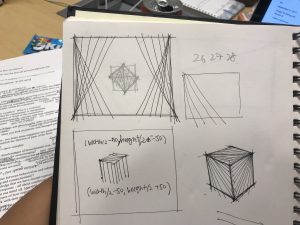
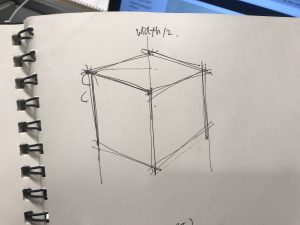
Originally my plan was a little more complicated than the final product; however, I was still able to achieve something that looks like a cube.


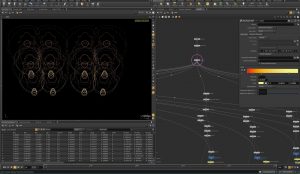
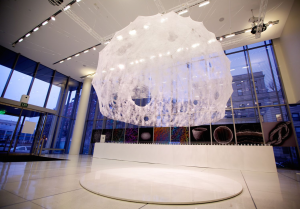
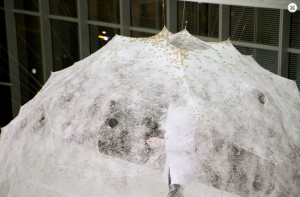
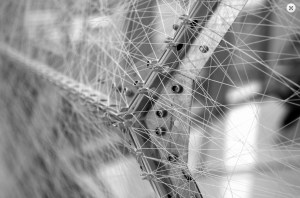 line of thread, an algorithm was created to mimic the single continuous style of the natural silkworm pattern and the variation of density of the fabricated threads. 26 panels of this silk scaffold was made and put together to make a dome. Then, silkworms were put into the dome structure to fill in the gaps with their own biological silk structures.