mmiller5-Looking Outwards-07


Google News results by year appear in the physical bar graph, Centograph

Centograph is a dynamic physical bar graph made by Tinker in 2009.  Users type a keyword into a desktop computer connected to Centograph which then searches the Google News Archives for the number of times that word was used in articles since 1909.  Centograph then displays word usage by raising physical bars representing 10 year spans, giving a physical representation of the data.  Centograph is a permanent installation at St. Paul’s School for Boys, which is part of why I think it’s so cool — it’s made specifically for an educational setting.  By turning data from something esoteric into something tangible and cool, it helps to incite a level of interest in the areas of computation and data visualization, especially in students.

ashleyc1-Section C-Looking Outwards-07

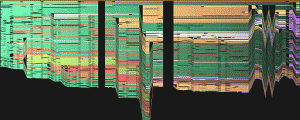
history flow for “Abortion” page, versions equally spaced.
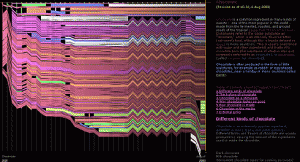
history flow for “Chocolate” page, versions equally spaced.


History Flow (2003) is a project by Fernanda Viegas in collaboration with Kushal Dave and Johnathan Feinberg which calculates and visualizes the changes of wikipedia articles. They calculated the changes by using tokens, or html tags in their program sentences to compare and capture changes in the articles. Although I don’t have access to the details, the Fernanda Viegas collaborated with IBM researchers. Their software was also able to determine who and at what age the author of the changes was and visualized these variants with different colors and sizes. Any time there is a black space, this indicates the article was vandalized or parts were blacked out which brings a lot of political undertones when seeing it in the context of a abortion wiki article.

This project is interesting because it brings up questions about censorship and the freedom to alter and edit text on a platform that is often referenced for the general public. From a visual standpoint, it’s also interesting to see the designs change and deviate significantly from the initial pattern and makes you think about what sort of conflict was going on and at what point can two (or more) authors of different opinions on a topic come together and agree what information is a determined fact to include in the article.

Artist Page:

http://bewitched.com/historyflow.html

Papers Written About Process:

http://alumni.media.mit.edu/~fviegas/papers/history_flow.pdf

http://hint.fm/papers/wikipedia_coordination_final.pdf

mjeong1-Looking Outwards-07-sectionA

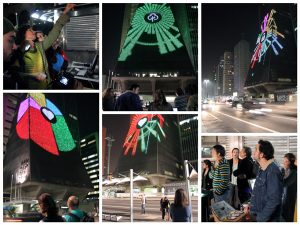
“Smart Citizen Sentiment Dashboard Sao Paulo” by  Moritz Behrens. The installation is displayed on the media façade of the Galeria de Arte Digital.

Citizen Feedback to Visual Language

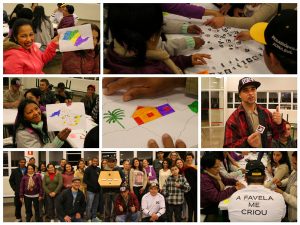
The project called Smart Citizen Sentiment Dashboard (SCSD) is an interactive media installation that translate set of data from the citizens into visual language. The screen is divided into three low resolution LED façades which are connected to the main computer through VGA connection. Data sets are collected through a number of workshops in which the artists invited citizens from Sao Paulo with different social and economic background.

The visualization of the data set is generated through RFID technology, facilitating on the ubiquitous Bilhete Unico travel card. The purpose of this project was to utilize this smart technology not only for travel purpose and allow citizens to express their opinion in the technology mediated urban realm.

Moritz Behrens succeeded not only in effectively translating the collected data into visual language but also in chose what kind of data they wanted to translate. Their decision to hear opinions from citizens deserves admiration since they newly opened a window for Sao Paulo’s citizens to have chance to express their feelings to public.


Link to Moritz Behrens

Bettina-LookingOutwards-07

Screenshot of a person interacting with the project, “We Feel Fine”. Find the project page here, and the site itself here.

This interactive site, We Feel Fine, was made in 2005 and searches the internet every 10 minutes for expressions of human emotion on blogs and then displays the results these dynamic representations. Not only is the result beautiful, but this piece also helps connect people around the world by seeing others who share similar feelings as we are right now. I’d imagine to implement this, one would need to parse content from sites (perhaps use API’s?) but perhaps the logic would be similar to the concept of strings, and searching through each word in a string and matching them to words in emotion dictionaries. There could also be work with the d3.js library which is made for data visualization.

I also admire how this digital piece was also turned into a print piece. As a designer, I am always searching for how we bridge the gap between print and digital mediums, and this system seems to have either piece suit the medium quite well: the digital piece serves to collect and display data in real time, where as the print piece memorializes moments and interesting findings.

aranders-lookingoutwards-07

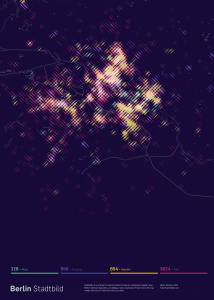
The 2013 project Stadtbilder by Moritz Stefaner is a representation of where cities are most bustling with activity. It is a nontraditional map that allows viewers to see various aspects of a city, such as food, nightlife, shopping, and music. I admire the innovative way that Stefaner viewed cities. It is a project that allows people to see where the fun activities of a city are and then find them with the street map overlay. The refined visual representation also adds to the appeal of the project. The algorithms that Stefaner used must have accounted for the geography of the cities, while creating the shapes and colors for the map. The project truly embodies the artist’s website name of “Truth & Beauty.” The project gives viewers information in a visually pleasing manner. link

link 2

alchan-Looking Outwards 07

(an example of the July 12, 2013 “Manhattanhenge”)

NYCHenge, created by the Carto team in 2013, is a project that visualizes how the sun aligns with the streets of New York City, inspired by the two times a year the sun lines up with the midtown grid of streets (“Manhattanhenge”). Sun-alignment is indicated by orange or red colors; the more red the color gets the more in-line the sun will be with that particular street. Users can explore the entire city of New York (not just Manhattan) across the entire year to find other, mini-henges or just figure out when the sun will shine in their faces as they’re driving down certain streets. It’s created with Open Street Maps, CartoDB tools, and the SunCalc javascript library to figure out the sun position.

I was drawn to this project because of its interesting focus, and the way it’s both interactive and relatively easy to understand. One downside to the simplicity of the map is that non-New-Yorkers will probably have trouble identifying the unlabeled streets, but the general gist of the project is still obvious.

Jonathan Perez Project 6

sketch

//Jonathan Perez
//Section B
//jdperez@andrew.cmu.edu
//Project-6


function setup() {
    createCanvas(480, 480);
    background(255);
}

function draw() {
    var y1 =-50
    var y2 = -200
    var dy1 = random(-1, 1);
    var dy2 = random(-1, 1);
    var irisColor = 0 //lower bound on random greyscale for second hand
    var irisColor2 = 10 //upper bound on random greyscale for second hand
    var irisFill; // iris coloring
    var brightCap; // max greyscale value iris color can be

    //iris darkness caps
    if(hour() >= 0 & hour() < 7) { //almost black at night-time
        brightCap = 100
    } else if(hour() >= 7 && hour() < 8) { //light grey during sunrise
        brightCap = 200
    } else if(hour() >= 8 && hour() < 19) { //light grey to white during the day
        brightCap = 300
    } else if (hour() >= 19 && hour() < 20) { //same as sunrise
        brightCap = 200
    } else { //same as night-time
        brightCap = 100
    }

    push();
    translate(width/2, height/2);


    push();
    rotate(minute() * TWO_PI/60);
    stroke(0);
    strokeWeight(1);
    line(0, 0, 0, -height); //minute hands
    pop();

    //pupil detail
    push();
    if(hour() <= 12) {
        rotate(hour() * TWO_PI/12);
    } else {
        rotate(hour() * TWO_PI/12 + TWO_PI/24); //offsets to continue creating more vertices
    } 
    stroke(0);
    fill(0);
    rect(-30, -30, 60, 60); //stacked squares to create a star-pupil shape
    pop();


    //iris detail
    push();
    rotate(millis() * TWO_PI/60000);
    for(i = 0; i < 80; i++) {
    if(irisColor2 < brightCap) { 
        irisColor += 3.5
        irisColor2 += 3.5
    }
    irisFill = random(irisColor, irisColor2);
    strokeWeight(2);
    fill(irisFill);
    point(0, y1); //inner detail
    point(0, y2); //outer detail
    if(y1 + dy1 < -120) {
        dy1 = random(1.5); //max range is 120
    } else if(y1 + dy1 > 0) {
        dy1 = random(-1.5);
    }
    if(y2 + dy2 < -200) { //max range is 200
        dy2 = random(1.5);
    } else if(y2 + dy2 > -100) {
        dy2 = random(-1.5);
    }
    y2 += dy2;
    y1 += dy1


    }

    pop();
}

For this project, I wanted to mimic the circular shape of the traditional clock in something organic. Incidentally, while playing around with some random behavior, I stumbled across the human eye as inspiration.

This project feels pretty incomplete, and I would like to implement some changes relating color to time. For instance, perhaps the color of the iris could mimic the color of the sunset or something.

Nayeon-Project06-Abstract Clock

nayeonk1

//Na-yeon Kim
//15-104, B section
//nayeonk1@andrew.cmu.edu
//Project-06 (Abstract clock)


var x = [];
var y = [];

function setup() {
    createCanvas(400, 480);
    frameRate(15);
    angleMode(DEGREES);
}

function draw() {
    background(20, 40, 60);
    noStroke();

//variables for times
    var H = hour();
    var M = minute();
    var S = second();

    var mappedH = map(H, 0, 23, 120, 300);
    var mappedS = map(S, 0, 59, 0, 30);

//small stars
    fill(250);
    for (var i = 0; i < x.length; i++) {
        var ex = x[i];
        var ey = y[i];
        ellipse(ex, ey, 5, 5);
    }

//wall
    fill(80, 65, 30)
    rect(0, 350, width, 130)

//moon
    fill(250, 255, 90)
    ellipse(120, 80, 100, 100);

//moon eclipse by hours
    fill(10, 30, 50);
    ellipse(mappedH, 80, 100, 100)

//star
    fill(230, 230, 30);
    var a = [250, 260, 280, 270, 270, 250, 230, 230, 217, 240];
    var b = [138, 157, 163, 180, 202, 193, 202, 180, 163, 157];
    var nPoints = a.length;

    beginShape();
    for (var i = 0; i < nPoints; i++) {
        var px = a[i] + random(-1, 1);
        var py = b[i] + random(-1, 1);
        //star goes down by minutes
        vertex(px, py + M);
    }
    endShape(CLOSE);

//window
    push();
    strokeWeight(50);
    stroke(0, 115, 130);
    noFill();
    rect(0, -25, width, 350)
    pop();

//table
    fill(80, 28, 10);
    arc(370, 440, 400, 150, 0, 180, CHORD);
    fill(150, 78, 60);
    ellipse(370, 440, 400, 100);

//ashtray shadow
    push();
    rotate(5);
    translate(300, 420)
    fill(80, 28, 10);
    ellipse(0, 0, 130, 50)
    pop();

//ashtray
    fill(80, 100, 100)
    arc(250, 430, 100, 30, 0, 180, CHORD)
    rect(200, 410, 100, 20)
    fill(100, 120, 120);
    ellipse(250, 410, 100, 20)
    fill(50, 60, 60);
    ellipse(250, 410, 80, 10)

//cigarretts
    push();
    rotate(20);
    translate(310, 300)
    fill(230, 230, 230);
    rect(0, 0, 50, 10);
    fill(200, 200, 50);
    rect(30, 0, 20, 10);

//cigarrett smoked by seconds
    fill(0);
    rect(0, 0, mappedS, 10)
    fill(250, 20, 20);
    rect(mappedS, 0, 2, 10);
    pop();

//smokes come up by seconds
    fill(250, 250 - 7 * S);
    ellipse(170, 370 - S, mappedS + 10, mappedS + 15)
    ellipse(190, 390 - S * 1.5, mappedS + 15, mappedS + 10)
    ellipse(180, 375 - S, mappedS, mappedS)
    ellipse(200, 380 - S * 3, mappedS + 10, mappedS)
    ellipse(200, 385 - S * 2, mappedS + 10, mappedS + 10)
    ellipse(190, 383 - S * 3.5, mappedS + 30, mappedS + 30)

//flower pot
    fill(120, 50, 10)
    quad(50, 250, 150, 250, 130, 300, 70, 300)
    rect(45, 230, 110, 30)

//flower patel shows up every 5 min
    push();
    fill(230, 100, 100)
    translate(100, 180)
    var i = (M - (M % 10))/5;
    for (var f = 0; f < i + 1; f++) {
      ellipse(0, -20, 10, 30);
      rotate(30);
    }
    pop();

//hours text
    fill(240);
    text("hour : " + H, 30, 400);
    text("Minute : " + M, 30, 420);
    text("Second : " + S, 30, 440);
}

//small stars show up when click
function mousePressed() {
  x.push(mouseX);
  y.push(mouseY);
}

My favorite time of the day is smoking at very late night while watching stars and moon. During the day, it’s too busy to feel the time. But night, every smokes from cigarett tells me of every moment of time.
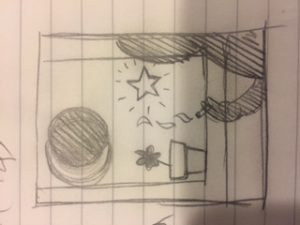
nayeonk1-LookingOutwards-06

Computational art using processing

For this assignment, i needed to search what computational art means. After research, I tried to figure out randomness of the art. It’s still confusing, but I found some art work related to this week’s assignment.
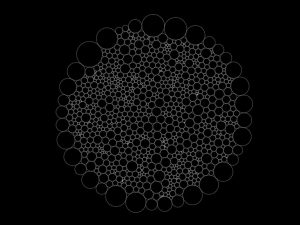
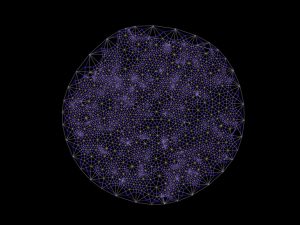
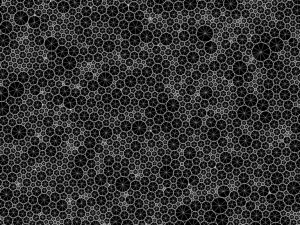
Miu ling lam used processing language to create beautiful computational art with randomness. She used her own algorithm which is ‘active sensor network diployment for maximal coverage’. I’m not fully understanding what this thesis for, but the thing is she implemented this algorithm to create images with processing language that I’m studying right now. All those lines and colors look random but they have complex mathmatical algorithm inside and it makes me excited about this processing language. I will try more to understand how she were able to create the arts with computer language.

HaeWanPark-LookingOutwards-6

Random Number Multiples by Marius Watz and Jer Thorp

Computer generated or software based art is usually played in a digital interface not executed in traditional craft or handwork. However, this ‘Random Number Multiple’ series are computer generated but screen-printed work. There are few series in ‘Random Number Multiple’. What I personally like is the ‘Arc’ series. Marius Watz described this series as “pseudo-random compositions of radial shapes, subtly distorted by a 3D surface that lends the image a strong focal point and sense of movement.” Actually, pseudo-randomness is not a real randomness. This randomness generated by a definite computer program to satisfy a statistical test. Even if it seems random but the composition of this series is actually generated by mathematical processes. I really admire this project because it combines traditional hand-craft method and software- or computer-based method together. I think it expands more possible ways of executing art expression.

The ‘Arc’ Series
The ‘Arc’ Series
The ‘Arc’ Series – Process of Screen Printing

Random Number Multiple Series